


Lease or Sell IPv4: The Break-Even Math Explained
Discover when it's smarter to sell or lease IPv4 addresses. Real numbers, ROI models, and market data to guide your next IP monetization move.

Artem Kohanevich
Co-Founder & CEO at IPbnb
Last updated
Table of Contents
item
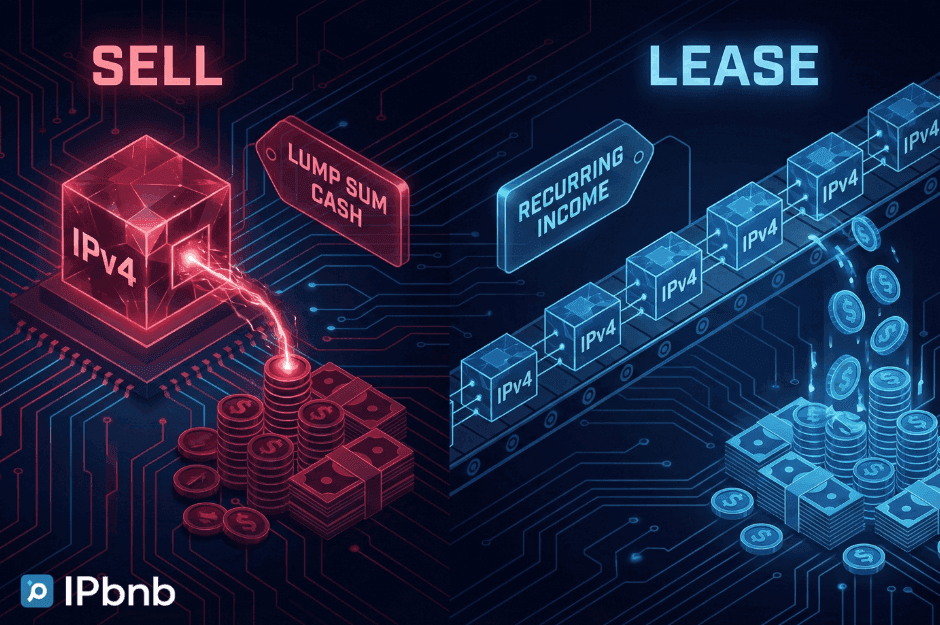
When Cogent Communications, one of the world's largest network providers, began monetizing its surplus IPv4 space, it quickly turned into a meaningful business line. Public filings show that Cogent owns tens of millions of IPv4 addresses and leases a significant portion of them to other networks. In recent years, Cogent has consistently reported growing demand for IPv4 leases, with millions of addresses under contract and a recurring revenue stream that now appears regularly in its quarterly results – a model that shows how large holders can both lease and sell IPv4 addresses to maximize the value of their space.
Fast forward to mid-2025, and the number keeps climbing – in Q2 2025, Cogent reported $15.3 million from IPv4 leasing in a single quarter, with Q3 figures rising even further.
Analysts generally value Cogent's IPv4 portfolio in the hundreds of millions of dollars at today's market prices - a tempting prospect for any CFO considering a sale. But Cogent has chosen the long game: keeping ownership while collecting predictable, recurring revenue.
And that's exactly the dilemma many address holders face in the sell-vs-lease IPv4 debate. Selling IPv4 blocks has become an increasingly complex decision as prices for large blocks have softened - some dropping below $20 per IP - while leasing platforms continue to show stable demand around $0.40 per IP per month. The question is no longer simple:
Whether you want to sell IP addresses or lease them out for recurring income, the decision comes down to your time horizon and financial goals. Should you cash out now, or earn consistent returns over time?
That's where break-even math comes in.
In this post, we'll dig into the real economics behind the sell-or-lease decision. With updated 2025 market data and live platform benchmarks, we'll look at payback timelines, occupancy sensitivity, and the scenarios where leasing IPv4 space truly pays off – and when selling still makes more sense.
The 2025 IPv4 Market Overview
Let's begin by taking a high-level view of where the IPv4 marketplace stands in 2025 – so you understand the backdrop behind any decision to sell IP addresses or lease IP addresses.
Lease price & utilization benchmarks
On the leasing side, platforms such as IPXO show that the average monthly lease rate across all blocks and regions over the past 90 days is about US $0.41 per IP/month, with utilization running at roughly 80%.
In other words, demand remains strong, and pricing is reasonably stable. Lease rates have ticked down slightly since their 2024 highs, but utilization has held steady – suggesting that customers are still willing to pay, though they're seeking better value for money.
Sale price dispersion by block size
On the sale side, however, volatility has returned. According to industry reports, in June 2025 the average price for a /16 block fell below US $20 per IP for the first time since 2019. Smaller blocks (for example, /20 to /24) have proved more resilient, but large blocks are clearly facing downward pressure.
This divergence is key: large holders are contending with weaker pricing and slower sales cycles, while smaller allocations continue to find buyers more easily.
IPv4 Price Per IP: Selling vs. Leasing at a Glance
Understanding the IPv4 price per IP is essential when comparing your options. At current market rates, a /16 block trades at roughly $18-$25 per IP as a one-time sale - meaning a /16 (65,536 IPs) could generate $1.18M-$1.64M upfront. By contrast, leasing the same block at $0.40/IP/month at 80% utilization yields approximately $21,000/month, or $252,000/year - with ownership retained. Over a five-year horizon, that's $1.26M in lease revenue alone, before any eventual resale. The right choice depends on your time horizon, liquidity needs, and confidence in the market.
If you decide to sell and your buyer needs IPs, point them to buy IPv4 on IPbnb.
Leasing offers more dependable, recurring cash flow and stable pricing, while selling – especially large blocks – involves greater timing uncertainty and more variable value. Your optimal strategy depends on block size, region, utilization level, and whether you prefer steady revenue or a one-time capital gain.
Sell or Lease IPv4 Addresses: The Cashflow Equation
If you own IPv4 addresses, you're sitting on a digital asset that keeps generating value. The big question is how to capture it: should you sell your IPs now for a lump sum, or lease them out to earn a steady stream of monthly income? To make that choice, let's break down what you actually control – and how those choices shape your returns.
Many organizations choose to sell IPv4 addresses when they need immediate capital or plan to exit the market entirely. Organizations looking to sell IP addresses should consider the timing carefully - especially given the current price softness in large blocks. IPv4 monetization through leasing offers a compelling alternative: predictable monthly income without giving up ownership. For a deeper look at both approaches, see our IPv4 monetization guide.
The Levers You Control
When you lease instead of sell, your outcome depends on a few variables you can directly influence:
Leasing rate (L): the monthly price per IP you set or negotiate.
Utilization (u): the percentage of your IPs actually leased at any time (typically 50–90%).
Fees (f): the platform's share – in IPbnb's case, the owner commission varies between 12% and 17%, based on turnover and contract conditions.
Operating costs (c): small but real – things like abuse cleanup, routing checks, or admin overhead.
Holding horizon (T): how long you plan to hold before selling (if ever).
Resale value (Pₜ): what you expect to sell the block for later.
Together, these act like dials on a dashboard. Adjust them, and you'll see how fast leasing catches up with selling.
Turning the Math Into a Picture
Think of it like this:
Selling is like taking a one-time payout today.
Leasing is like buying a rental property – you earn rent (lease income) every month and can still sell the asset later.
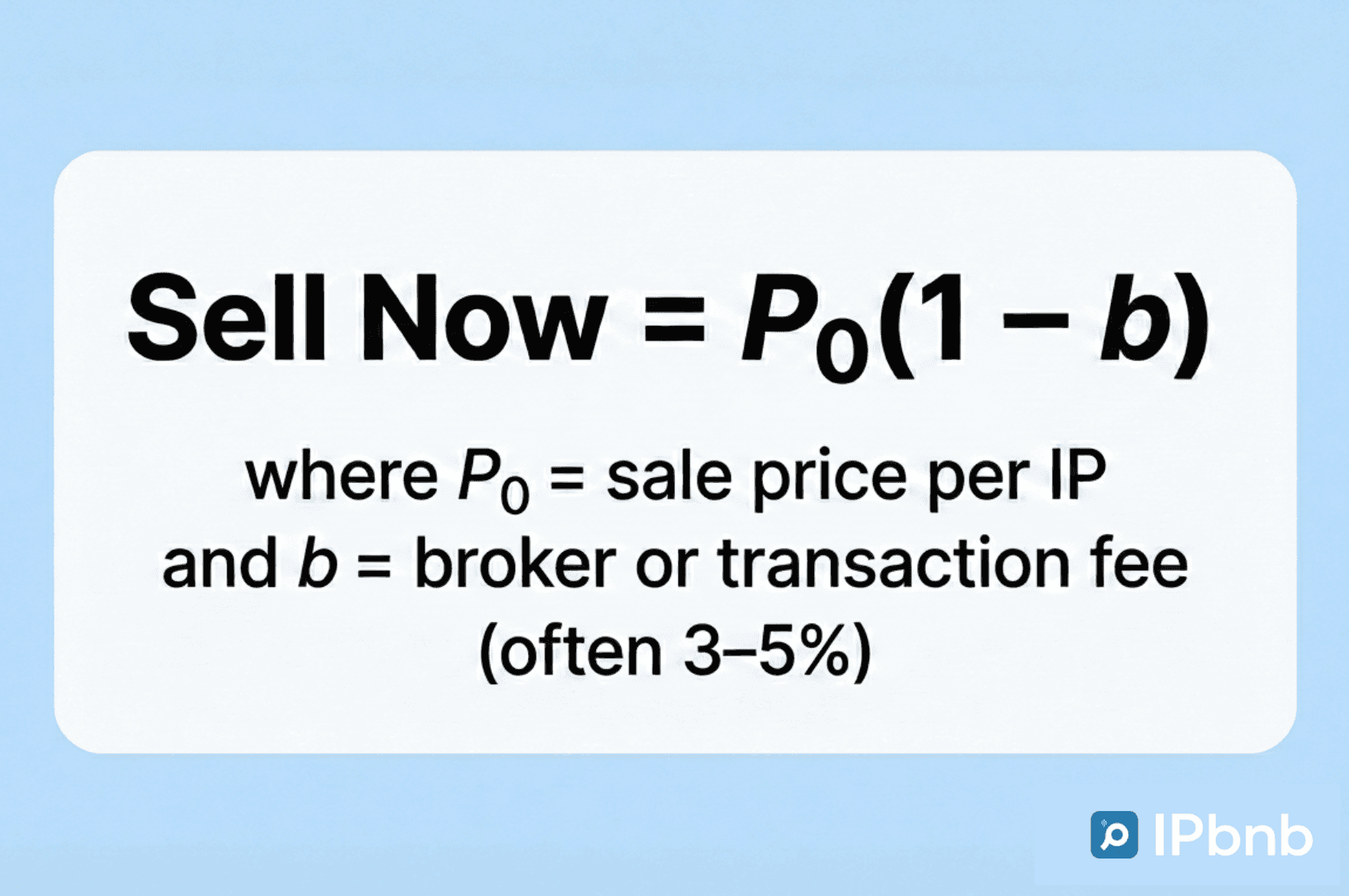
Mathematically, it looks like this:
Sell now (per IP):
Lease, then sell later (per IP):
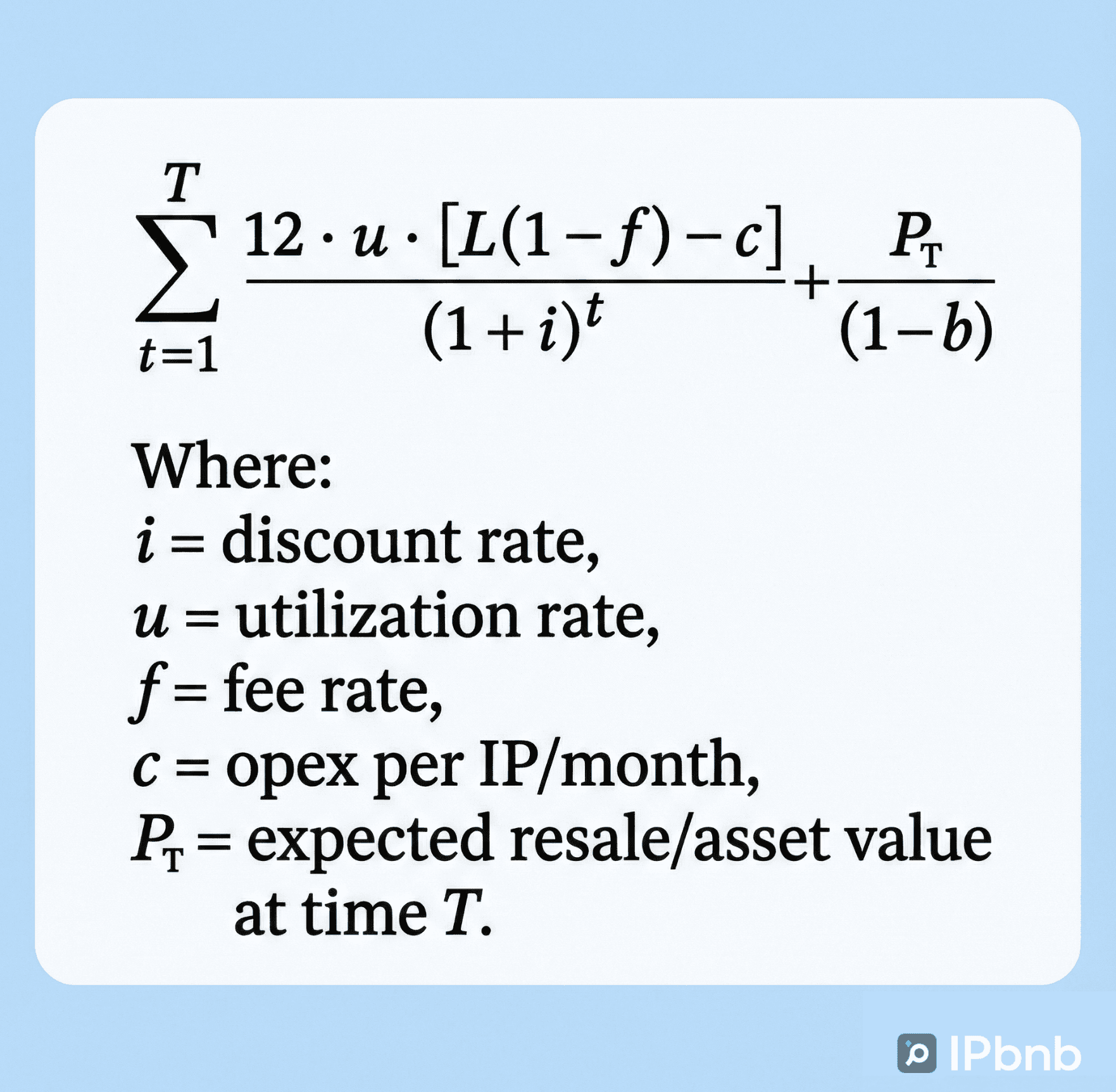
Here's what that means in plain English:
Every month, you collect lease income (adjusted for utilization, fees, and costs). Then you discount those future payments – just like you would for a bond – and finally add what you'll get from selling the IPs later.
Your break-even point is the year when this total equals what you would've earned from selling upfront.
Heatmap: How Occupancy and Rate Affect the "Years to Beat Selling"
Picture a heatmap where:
Y-axis: Occupancy (from 50% to 90%)
X-axis: Monthly lease rate (e.g., $0.30, $0.35, $0.40, $0.45 per IP)
A few simplified, no-discounting examples:
At 50% occupancy and $0.30/IP, the payback period is over 10 years.
At 80% occupancy and $0.40/IP, payback drops to about 5.5 years.
At 90% occupancy and $0.45/IP, the period shortens further to around 4.8 years.
These estimates highlight how sensitive the economics are to both utilization and rate. Even small decreases in occupancy or pricing can significantly extend the time required for leasing to outperform selling.
Policy Timing & Liquidity (Regional Differences)
Policy restrictions and liquidity timelines vary across RIRs (Regional Internet Registries), which can strongly influence whether selling or leasing is more practical in the short term.
RIPE NCC (Europe): A 24-month transfer restriction after address allocation. Learn about RIPE NCC membership costs in 2026 – annual fees have risen 28% since 2022.
ARIN (North America): The source organization must not have received a transfer in the prior 12 months.
APNIC (Asia Pacific): Some ranges, such as the 103/8 pool, require a five-year holding period before transfer.
LACNIC (Latin America): Typically enforces about 12 months between transfers.
These policies limit how quickly you can monetize via sale, which makes leasing a more flexible and liquid option in several regions.
When IPv4 Leasing Outperforms Selling
Leasing IPv4 isn't just a temporary fix – it can be a smarter, faster, and more flexible financial move in many real-world situations. Below are the most common cases where leasing wins, backed by 2025 market data and verified sources.
Factor | Leasing IPv4 | Selling IPv4 | Key Insight (2025) |
|---|---|---|---|
Typical rate/price | $0.40–$0.50 per IP/month | $18–$25 per IP for /16 blocks | Lease prices stable; sale prices declined ~40–50% YoY |
Revenue structure | Recurring monthly income | One-time payout | Leasing provides steady OPEX revenue; selling offers instant liquidity |
Ownership | Retained | Transferred permanently | Leasing keeps long-term optionality; selling ends ownership |
Flexibility/liquidity | High – scale up/down fast | Low – transfers locked 12–24 months | Leasing avoids RIR hold-ups |
Operational risk | Requires tenant vetting, abuse control, KYC | Minimal after sale | IPbnb pre-screens all renters & monitors reputation 24/7 |
Cash-flow profile | Predictable monthly OPEX | Large one-off CAPEX inflow | Leasing smooths income; selling boosts short-term liquidity |
Best for… | Short/uncertain horizon, startups, pilots, M&A transitions | Owners exiting IPv4 market or needing immediate capital | Leasing suits 1–5 yr plans; selling fits full divestment |
Should You Sell Your IPv4 Space?
The decision to sell IPv4 space is different from selling individual blocks - and it's worth understanding the distinction. When you sell IPv4 space, you're typically transferring a larger allocation (a /16 or /18, for example) through a formal RIR-mediated process, often involving brokers, escrow services, and multi-week transfer timelines. Individual block sales (/24s or /23s) tend to move faster and attract a wider buyer pool.
If you're considering whether to sell IPv4 space in full or in parts, the answer often depends on how quickly you need liquidity and whether you're willing to manage multiple transactions. Platforms like IPbnb give owners flexibility: list your space for leasing now, and revisit the sell decision later - without locking yourself in.
Short-Term or Uncertain Needs
If you're unsure whether you'll need the block for more than three to four years, leasing often makes more sense than buying.
Recent data from IPXO and other platforms show average lease rates around $0.40–$0.50 per IP per month, depending on block size and reputation. Meanwhile, the purchase market has turned volatile – large /16 blocks dropped below $20/IP in mid-2025, down from around $45–$50/IP just a year earlier.
Why it matters: If you buy and then sell into a downswing, your IRR (internal rate of return) drops sharply. By choosing to lease IP addresses, you match your spending to usage and avoid the risk of mistiming the resale market.
Fast Scaling and Flexibility
Leasing lets you scale up or down – and even distribute across regions – within weeks, while regional registry (RIR) transfer rules can delay ownership transfers for months or even years. These rules can limit liquidity for owners.
Platforms like IPbnb simplify the process by acting as a trusted mediator between IPv4 owners and tenants, handling screening, routing authorization, abuse monitoring, and reputation management. That means less paperwork, faster onboarding, and a safer way to lease IPv4 space at scale.
Here's how to list your IPs on the IPbnb marketplace in under 30 minutes.
With professional IP leasing services like this, you can expand, relocate, or exit projects without waiting periods or complex policy approvals.
Cloud Deployments and Cost Control
Since February 1, 2024, Amazon Web Services charges $0.005 per public IPv4 per hour (~$43/year) – but BYOIP (Bring Your Own IP) is exempt from that specific fee.
Leasing provides clean, routable space that can be brought to the cloud under BYOIP, cutting costs while freeing up capital. Case studies from providers like Prefixx show potential savings of several thousand dollars per year for cloud-heavy workloads, depending on configuration and scale.
OPEX Instead of CAPEX
Buying medium or large IPv4 blocks remains a capital-heavy investment, often running into hundreds of thousands or even millions of dollars. Leasing, on the other hand, turns that into a predictable monthly operating expense (OPEX) – ideal for managing cash flow and budgeting.
For startups, seasonal businesses, pilot programs, or M&A transitions, leasing provides the flexibility to move quickly without locking funds into long-term assets. It also fits naturally into modern IP address management strategies built around efficiency and adaptability.
Testing, Scaling, and Exiting Smoothly
Leasing gives teams the freedom to experiment – test new regions, launch campaigns, or run pilots – and then exit cleanly when the project wraps up. No resale headaches, no asset depreciation.
Market analyses from CircleID and IPXO show that lease prices have remained relatively stable, while sale prices swing more sharply by block size and region. Leasing protects you from that volatility and helps you plan with confidence.
How to Sell IPv4 Addresses
If leasing doesn't fit your situation, selling remains a well-established option - but it requires preparation and realistic expectations.
Step 1 - Verify your block's transferability. Check your RIR's holding period rules. RIPE NCC requires 24 months; ARIN requires 12 months since your last received transfer. Attempting to sell before these windows close will halt the process.
Step 2 - Assess your block's reputation. A clean IP reputation directly affects sale price. Run your block through reputation tools (Spamhaus, ARIN Whois, BGPView) before listing. Blocks with abuse history sell at a discount or may require remediation first.
Step 3 - Choose your selling route. You can sell IPv4 addresses through a broker (who handles matching, escrow, and RIR paperwork for a commission of roughly 3-5%), through a direct marketplace, or peer-to-peer. Brokers are slower but lower-risk; direct listings are faster but require more due diligence on your end.
Step 4 - Price realistically. Current market data shows /16 blocks trading below $20/IP, while /24s hold closer to $22-$25/IP. Pricing above market will extend your time-to-sale significantly.
Step 5 - Complete the RIR transfer. Once a buyer is found and funds are in escrow, the RIR processes the transfer - typically within 5-15 business days depending on the registry.**
Total timeline: expect 4-12 weeks from listing to completed transfer, depending on block size, region, and how quickly a buyer is matched.
Hidden Risks in the Sell vs Lease IPv4 Decision
When you're running the numbers on whether to sell or lease IPv4 addresses, don't overlook the operational and policy risks that can quietly erode your returns. The math might look clean on paper, but real-world execution often introduces hidden costs and delays.
Reputation, Abuse, and KYC Challenges
Leasing means you'll occasionally change tenants – and every new renter brings potential exposure to abuse or blacklisting incidents. Even a small number of problematic users can affect your block's reputation and future earning potential.
Platforms like IPXO report that about 97–98% of abuse cases are handled automatically, but proactive monitoring, post-lease cleanup, and Know-Your-Customer (KYC) verification still require time and attention. If you lease regularly, it's smart to budget a small "reputation buffer" to cover cleanup and downtime between tenants.
Meanwhile, IPbnb goes a step further – it checks every IP block and screens each renter before approval, ensuring full compliance and traceability. The platform also monitors reputation and routing in real time, guaranteeing that your leased IP address stays clean throughout the contract term. This extra layer of due diligence helps owners earn passive income with confidence, without worrying about blacklisting or misuse.
Fee Transparency and Cost Layers
The sell vs lease IPv4 equation can shift depending on how fees are structured.
Typical costs include:
Platform fees: around 15% on most marketplaces.
Broker or escrow fees: when you sell IPv4 addresses directly.
Transfer or policy fees: charged by regional internet registries (RIRs).
Administrative overhead: setting up contracts, verifying tenants, and managing reputation.
While these fees are manageable, ignoring them can distort your ROI model – especially for smaller blocks.
That's why platforms like IPbnb prioritize full financial transparency for both IPv4 owners and renters. All commissions, platform fees, and payout terms are clearly stated upfront, so you always know what portion of the revenue you keep and what goes toward service costs. This clarity helps owners plan realistic ROI expectations and gives renters confidence that they're working within a fair, predictable financial framework.
Policy Lock-Ups and Timing Delays
Every region has its own transfer timeline, which becomes important if you plan to sell IP addresses after leasing them. For example, RIPE NCC, which covers Europe, requires a 24-month holding period before resale.
If your strategy involves leasing first and selling later, these restrictions can extend your expected horizon. Make sure to factor these timing rules into your model before deciding how to monetize your IPv4 assets.
Leasing can offer predictable income, and selling can unlock fast liquidity – but each path comes with its own operational and compliance "gotchas."
Understanding the sell vs lease IPv4 trade-offs in context – fees, policy rules, and reputation management – helps you make a decision that maximizes value and minimizes unpleasant surprises.
IPv4 as an Investment Asset
Beyond the lease-vs-sell decision, it's worth stepping back to consider IPv4 as a long-term investment asset. Unlike most digital infrastructure, IPv4 addresses are genuinely scarce - IANA exhausted its free pool in 2011, and the remaining RIR pools are nearly depleted. That structural scarcity has underpinned price appreciation over the past decade, even as short-term volatility has returned in 2024-2025.
For owners treating their blocks as part of a broader investment portfolio, leasing provides yield while preserving the asset - similar in principle to holding income-generating real estate. Selling, by contrast, converts a potentially appreciating asset into cash today. Which approach makes more sense depends on your view of long-term IPv4 demand, your cost of capital, and your confidence in the market's recovery. For a deeper analysis of IPv4 as an investment, see our IPv4 investment guide.
Wrapping It Up
When it comes to leasing vs selling IPv4 addresses, the right move depends on your goals and time horizon – but in the 2025 marketplace, leasing is often the more advantageous option in many common cases.
Selling produces an immediate cash payout, but it's a one-time event that gives up any future upside (if demand or prices recover). Furthermore, with sale prices for large blocks declining in mid-2025 (e.g., /16s under $20/IP), selling during a soft market may limit your long-term return.
Leasing, by contrast, transforms otherwise idle addresses into a predictable monthly income stream — while you retain ownership, maintain optionality, and benefit from recurring revenue, provided your blocks remain clean and in demand. Many leasing platforms also handle routing, screening and reputation oversight, simplifying execution.
In short:
Sell if you want quick liquidity or plan to exit the IPv4 market entirely.
Lease if you prefer ongoing income, asset retention, and the flexibility to re-enter or reposition later.
For many owners in today's volatile market – especially those with short/uncertain timeframes or who prioritise agility over long-term ownership – leasing beats selling: it affords more control, more flexibility and more predictable returns while IPv4 remains scarce and strategically valuable.