


How to Choose the Best Provider to Lease IPv4 Addresses in 2026
Find the best IPv4 leasing provider for your needs. This guide breaks down what to check before signing any lease – from RPKI support to abuse handling.

Artem Kohanevich
Co-Founder & CEO at IPbnb
Last updated
Table of Contents
item
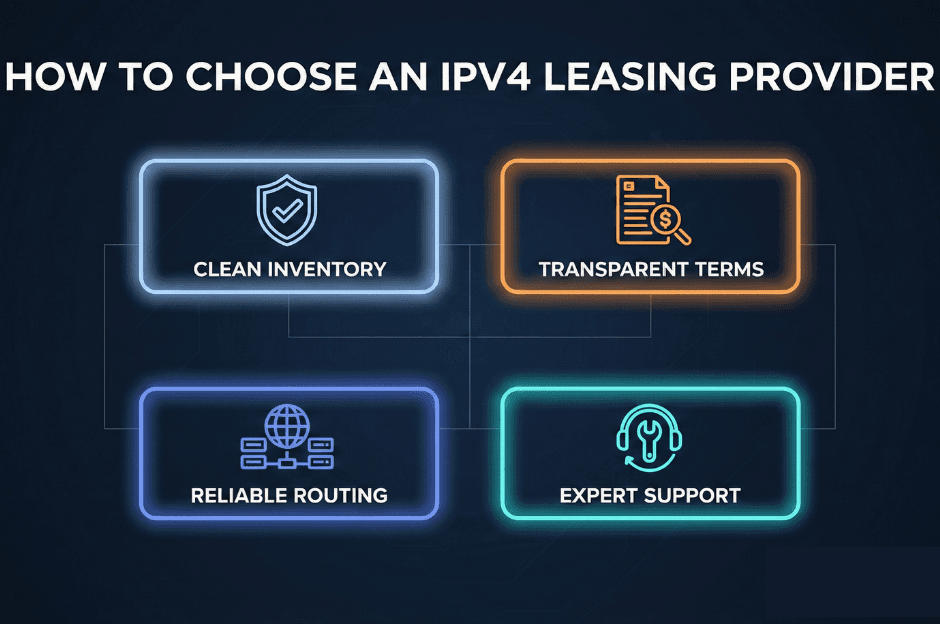
Leasing IPv4 addresses can be risky – choose the wrong IPv4 lease provider and you could lose money, face service disruptions, or inherit blacklisted IP space. But select the right partner, and you gain flexible, cost-effective scaling without the capital commitment of purchasing.
Read about the five most common leasing mistakes and how to avoid them.
So how do you capture the benefits of leasing while avoiding the pitfalls?
As IPv4 address scarcity pushes purchase prices into premium territory, a growing number of organizations are discovering a more flexible alternative: leasing – also known as IP rental services. Instead of committing significant capital expenditure to buy IP resources outright, businesses can lease IP addresses temporarily under contract – securing exactly what they need, when they need it, on terms that match their operational reality.
For a detailed breakdown of the buy vs. lease decision, see our dedicated comparison.
Whether you're rapidly scaling infrastructure, testing new geographic markets, or simply converting fixed assets into operational expenses, IPv4 leasing offers strategic advantages that ownership can't match. But not all IPv4 lease providers deliver the same quality, transparency, or reliability.
This comprehensive guide to choosing the best provider to lease IPv4 addresses cuts through the marketing noise to give you what actually matters: a practical framework, ready-to-use templates, and technical criteria for making an objective IPv4 provider decision. By the end, you'll know exactly which questions to ask, which metrics to measure, and which red flags to avoid.
10-Point Framework for Evaluating IPv4 Leasing Providers
Criteria | What to Check |
|---|---|
IP Reputation Verification | Ensure clean, RBL-free addresses |
LOA Delivery Speed (TTFLOA) | Measure time-to-first Letter of Authorization |
Abuse Handling Policies | Verify 24/7 response and resolution SLAs |
Contract Flexibility | Understand revocation terms and migration grace periods |
Pricing Transparency | Compare total cost, including hidden fees |
Technical Support Quality | Assess BGP, RPKI, and IRR expertise |
Uptime SLA | Confirm network availability guarantees |
Regional Coverage | Verify RIR and geographic reach |
Company Stability & Compliance | Check track record and certifications |
Customer Reviews & References | Validate real-world performance |
When Organizations Choose to Lease IPv4 Addresses
IPv4 leasing has become a strategic choice for businesses navigating the constraints of address scarcity. Here are the primary scenarios where leasing makes the most sense:
Rapid deployment without capital commitment
For organizations needing immediate access to IP resources, leasing eliminates this capital barrier. Many IPv4 providers provision accounts instantly, but LOA delivery typically ranges from several minutes to a few hours depending on automation and RIR region. Traditional RIR allocation is largely unavailable (RIPE/APNIC/AFRINIC have no IPv4 left, ARIN has a waitlist). Leasing is now the only realistic way to quickly obtain routable IPv4 space.
Geographic expansion with reduced risk
Before committing to permanent IP resources in unfamiliar markets, companies can lease region-specific addresses to validate infrastructure requirements, measure actual latency, and test market demand. This approach proves particularly valuable when exploring markets with unique compliance requirements or uncertain growth trajectories – you can establish presence, gather data, and scale intelligently without irreversible capital allocation.
Financial flexibility through OPEX conversion
Long-term leasing is typically 25–40% cheaper than purchasing over a 3–5 year horizon, depending on regional demand and price cycles. While simultaneously converting fixed capital expenditure into predictable operational expense. This shift improves cash flow management, simplifies budgeting, and preserves capital for core business investments. IPv4 purchase prices have stabilized after years of growth, making leasing financially attractive for teams prioritizing flexibility over capital spend.



What to Look for in an IP Leasing Company
Not every IP leasing company operates at the same standard. Before working through the 10-point checklist below, it helps to understand the qualities that separate reliable IPv4 lease providers from those that create operational risk.
A trustworthy IP leasing company will be transparent about its IP inventory, proactive about reputation monitoring, clear on contract terms including revocation rights, and able to provide verifiable references from customers with similar use cases. An IPv4 provider that avoids any of these areas during the evaluation process is sending a signal worth taking seriously.
The checklist below gives you a structured way to assess each of these dimensions in detail.
The 10-Point IPv4 Provider Comparison Checklist
Use this framework to objectively evaluate any IPv4 lease provider. For each criterion, gather specific evidence, define measurable KPIs for your contract, and watch for warning signs.
1. IP Reputation Verification Process
A reliable IPv4 lease provider should perform thorough pre-delivery reputation screening across major RBL databases such as Spamhaus and Proofpoint. This includes checking the AS history of each block, reviewing past abuse reports, and confirming that no outdated geolocation entries or legacy restrictions follow the IPs you intend to lease. For teams using IPs for email or marketing traffic, it's worth asking how the IPv4 provider approaches IP warming and whether they have guidelines for gradually increasing sending volume to build a positive reputation with mailbox services.
For a deeper dive into monitoring tools, see our IP reputation tools and best practices guide.
Evidence to request:
Pre-delivery reputation report for your specific block showing RBL status
Documented remediation policy when addresses appear on blacklists
Typical timelines for clearing listings (time-to-remediation)
Historical abuse patterns for the IP space you're considering
Clear contractual expectations also help prevent disputes later. Providers should state what portion of their IPs are RBL-free at delivery, how quickly they typically resolve listings when they occur, and under what conditions a block will be replaced. Be careful with IP rental services that promise to "clean IPs on request" without proactive checks or referenceable processes. A lack of pre-delivery documentation, refusal to share reputation reports, or marketing slogans about "clean IPs" without hard data are all warning signs.
The IPv4 market has steadily moved toward greater transparency. IPv4 lease providers who consistently maintain clean, well-monitored pools tend to stand out, while those relying on reactive or "best-effort" approaches often create operational risks. Network reputation directly affects deliverability, security, and customer trust - so it's worth demanding verifiable proof rather than accepting generic assurances.
2. LOA Delivery Speed (TTFLOA)
Time-to-First-LOA (TTFLOA) measures how long it takes from signing and paying for a lease to receiving the Letter of Authorization you need to announce the IP space. This metric directly shapes how quickly your team can bring new resources online.
Evidence to request:
Standard SLA for LOA generation (e.g., ≤4 business hours)
Emergency expedite procedures and associated costs
Timezone coverage for LOA requests
Automation level (instant vs. manual approval chains)
When reviewing commitments, look at the provider's average TTFLOA, the 95th percentile for occasional delays, and the percentage of LOAs delivered within their stated window. Contracts should also state what happens when that window is missed, including any service credits. Be wary of IPv4 providers with no defined SLA or no backup approval workflow for weekends and holidays, as well as those whose standard TTFLOA regularly stretches beyond 24 hours.
Many providers market "instant provisioning," but the real indicator of performance is how consistently they deliver usable LOAs after payment. Clear and measurable TTFLOA terms separate dependable IPv4 lease providers from those with unpredictable turnaround times.
To understand the technical steps behind leasing, read how IPv4 leasing actually works.
3. Abuse Handling Policies
Abuse complaints are a normal part of operating IP space at scale. A dependable IP leasing company runs a 24/7 abuse desk, follows documented response procedures, and applies policies that address real security issues without disrupting legitimate customers. The approach should be balanced: neither overly punitive nor careless with complaints that could damage the reputation of the wider IP pool.
Evidence to request:
Complete Acceptable Use Policy (AUP) document
Abuse complaint handling workflow and timelines
"Three strikes" or progressive discipline policy
Incident log retention periods
Communication channels (email, portal, phone)
Escalation procedures for disputed complaints
When reviewing a provider's processes, look for clear expectations around acknowledgment and resolution timelines, how false positives are handled, and what communication you will receive before any service impact occurs. Lack of measurable response targets, immediate suspensions without verification, limited transparency about complaint statistics, or vague AUP wording are all warning signs.
Legitimate customers need predictable and fair handling of abuse reports, while IPv4 providers that ignore complaints risk damaging the reputation of their entire IP pool. The strongest partners strike this balance through transparent procedures and consistent execution.
See how IPbnb handles this through our trust & compliance framework.
4. Contract Flexibility and Revocable Authorization
IPv4 leasing gives you temporary usage rights while ownership stays with the provider. Because control ultimately returns to them, it's important to understand the full lease lifecycle, especially how termination and revocation are handled.
A solid agreement identifies the true owner of the IP block and specifies the exact scope of delegation, including LOA terms and any sub-allocation limits. It should also define the circumstances under which access can be revoked - non-payment, policy violations, or natural contract expiration - and outline the notice period before revocation takes effect. Reputable IPv4 lease providers offer a reasonable window, typically 30–90 days, plus a grace period for migration. Clear steps for BGP withdrawal, WHOIS updates, and rDNS changes help you plan an orderly off-boarding process.
Evidence to request:
Standard LOA template showing delegation language
Revocation clause with specific notice requirements
Case studies of previous customer migrations
Technical support provided during off-boarding
Regional registries such as ARIN state that leasing never transfers ownership, and all prefixes must return to the lessor at the end of the term. Strong IP leasing companies acknowledge this and design contracts that give clients time and guidance to move their workloads without downtime.
Be wary of agreements with immediate revocation rights, no defined migration window, unclear ownership details, or language suggesting permanent rights to leased IPs. These issues contradict RIR policy and introduce unnecessary operational risk.
5. Pricing Transparency
The true cost of leasing from any IPv4 lease provider goes well beyond the monthly rate. To understand your total expense, you need visibility into all fees, discount structures, and contract terms. The base price – per IP or per /24 – is only one component. Commitment periods, volume discounts, and term-length pricing can significantly change the overall cost. Some IPv4 providers add setup fees or charge for tasks such as ROA or IRR updates, WHOIS changes, rDNS delegation, block moves, or early termination.
Contracts should spell out these details clearly. Rates should stay fixed for the full term, and invoices should itemize every charge.
Use our IPv4 pricing calculator to estimate current lease costs.
If the provider offers automatic volume-based discounts, the rules behind them should be explicit. Renewal pricing is also important; predictable increases or capped adjustments help you plan long-term costs.
Evidence to request:
Sample invoices showing fee breakdowns
Rate cards or published pricing schedules
Documentation of discount policies
Clear explanation of renewal pricing rules
Be cautious of IP rental services that hide pricing behind "contact us," bury fees in fine print, or introduce vague surcharges for "premium" or "clean" IP space. Large renewal jumps or confusing fee structures are also strong warning signs.
Transparent pricing is the foundation of cost-effective leasing. IPv4 lease providers with straightforward, well-documented pricing make financial planning simpler and reduce the risk of unexpected charges.
6. Technical Support Quality
IPv4 leasing involves complex networking tasks – BGP routing, RPKI validation, IRR updates, and reverse DNS configuration – so the strength of an IPv4 provider's technical support has a direct impact on deployment speed and operational stability.
A capable IP leasing company offers real 24/7 NOC coverage and engineers who can troubleshoot BGP issues, create or update IRR objects, generate RPKI ROAs, and manage rDNS delegation. For larger or more intricate setups, structured migration guidance or a dedicated onboarding engineer can reduce delays. Many modern platforms also support these processes with automation or well-documented self-service tools.
Response times, escalation paths, and support scope should be stated clearly in the contract. Defined targets for critical issues, accessible support channels, and publishable satisfaction metrics such as CSAT or NPS help you gauge the team's competence and reliability.
Evidence to request:
Sample support interaction transcripts
Technical documentation repository access
Engineer certification or expertise validation
Average resolution times by issue category
Be cautious of IPv4 providers that rely only on email, lack engineers who understand RPKI or IRR, or have no formal escalation process. Outsourced support with limited networking expertise or minimal onboarding assistance can also create problems later.
Whether you're new to announcing your own space or already experienced, responsive and knowledgeable support is a key part of a smooth IPv4 leasing experience.
7. Uptime SLA for Network Services
When an IPv4 lease provider combines leasing with services like BGP announcements, GRE tunnels, or IP transit, network availability becomes part of the offering. It's important to distinguish basic IP delegation – which has minimal infrastructure dependency – from connectivity services, where the provider's network performance directly affects your environment.
For IPv4 providers offering transport or routing support, look at the stability of their BGP sessions, the consistency of route announcements, and the quality of their uptime commitments. Latency, jitter, packet loss, DDoS mitigation, and maintenance practices all contribute to real-world reliability.
Contracts should define how availability is measured, the guaranteed uptime percentage, and what service credits apply when SLAs are missed. They should also outline maintenance windows, emergency procedures, and any performance expectations beyond simple uptime, such as regional latency targets.
Evidence to request:
Historical uptime reports and incident summaries
Public status page or transparency dashboard
Network architecture documentation showing redundancy
Peering relationships and global network reach
Be cautious of vague "best-effort" commitments, SLAs that exclude common outage scenarios, minimal service credits, or a lack of incident transparency. Claims of perfect uptime without proof are another warning sign.
If your lease includes connectivity, evaluate the IPv4 provider with the same scrutiny you would apply to any ISP. For straightforward IP delegation, these factors may be less central – but it's still helpful to understand any infrastructure dependencies built into their service model.
8. Regional Coverage (RIR & Geographic Distribution)
IPv4 addresses carry regional registry associations (RIPE NCC, ARIN, APNIC, LACNIC, AFRINIC) and geolocation data that affect routing, compliance, and content delivery. For teams operating across multiple markets, accurate regional coverage is critical.
When assessing an IPv4 lease provider's footprint, look beyond the RIR label. Real geographic distribution, reliable geolocation records, and documented update processes matter as much as the registry of origin. Regional compliance considerations – such as data-localization rules or jurisdictional requirements – should be clearly addressed. Local presence and region-specific LOA timelines also influence how quickly you can deploy.
Contract terms should clarify how inventory is spread across regions, the expected TTFLOA for each location, and the timeframe for updating geolocation data after allocation. Any regional procedures or restrictions should be stated upfront.
Evidence to request:
Current inventory availability list by region
Case studies demonstrating multi-region deployments
Partnerships with local data centers or hosting providers
Documentation of regional policy compliance
Be cautious of IP leasing companies that claim "global coverage" without breaking down what that actually means. A heavy concentration in a single RIR, an inability to supply region-specific IPs, incorrect or outdated geolocation records, or a lack of process for requesting specific geographic allocations are all signs that their coverage may not match your operational needs.
For organizations operating internationally, IP resources must align with the infrastructure footprint. While IPv4 addresses technically route worldwide regardless of origin, geolocation accuracy directly affects content delivery, ad targeting, fraud prevention, and regulatory compliance. IPv4 providers with diverse, well-distributed IP pools offer the flexibility needed to support global expansion as your business evolves.
9. Company Stability & Compliance
When you lease IPv4 space, you're placing part of your infrastructure in the hands of another organization – sometimes for years. That makes an IPv4 lease provider's stability, financial health, and compliance maturity essential to long-term service continuity and risk management.
A stable IP leasing company generally shows a meaningful history in the IPv4 market, manages a substantial volume of address space, and serves a broad customer base that may include well-known enterprise clients. Established partnerships with RIRs, internet exchanges, or major network operators can further indicate operational competence. Financial backing and a transparent ownership structure also help you understand whether the IPv4 provider can support future growth and withstand market fluctuations. Public case studies and real deployment examples provide additional reassurance that the team knows how to deliver at scale.
Compliance is equally important. Mature IPv4 lease providers implement robust KYC and AML processes, maintain clear audit trails for all IP delegations, and adhere to strong data protection and privacy standards. Some organizations go further by publishing industry certifications or detailed security documentation. Transparent governance and openness about corporate structure are strong signals that a provider takes accountability seriously.
Evidence to request:
Public company information and track record
References from similar-scale organizations
Compliance documentation relevant to your industry
Published security and operational policies
As you evaluate providers, keep an eye out for red flags. IP leasing companies that have only recently entered the market yet offer minimal operational detail, single-page websites, opaque ownership, or no willingness to provide verifiable references may pose unnecessary risks. A lack of documented compliance procedures or hesitation to disclose the size and growth of their managed IP inventory should also prompt caution.
The IPv4 leasing market includes everything from large telecom operators to niche brokers and new marketplaces. While company age alone doesn't determine quality, newer entrants must clearly demonstrate operational depth, financial reliability, and technical expertise. Enterprise buyers, in particular, tend to prioritize IPv4 providers with proven RIR relationships, transparent processes, and a documented history of stable performance.

10. Customer Reviews & References
Third-party validation offers a perspective you'll never get from provider marketing materials. Real customer experiences reveal how an IPv4 lease provider actually performs day to day – how quickly they deliver LOAs, how responsive support is during incidents, and whether clients remain satisfied over the long term.
Start by reviewing independent sources such as G2, Capterra, TrustRadius, industry forums, community discussions, and social media mentions. Direct reference checks are equally important: ask for contact details of two or three customers with similar use cases, and speak with them about TTFLOA, support responsiveness, pricing transparency, abuse handling, the length of their relationship with the IPv4 provider, renewal history, and any challenges they faced along the way.
It's also useful to understand the provider's broader customer satisfaction metrics. Request information such as NPS scores, average customer tenure, contract renewal rates, and expansion levels among existing clients – strong indicators of whether customers trust the IP leasing company enough to grow their deployments over time.
Evidence to request:
Public testimonials with verifiable company names
Video case studies or written success stories
Permission to contact listed references
Industry awards or recognition
Ultimately, customer retention and satisfaction metrics reveal an IPv4 lease provider's reliability far more accurately than polished sales materials. IP leasing companies that deliver consistent quality accumulate positive reviews, maintain long-term relationships, and openly connect prospects with existing customers. Conversely, repeated complaints about issues like hidden fees, slow support, or revocation disputes should be taken seriously.
Conclusion: Making Your Provider Decision
Choosing the best provider to lease IPv4 addresses requires a structured look at technical, operational, financial, and legal factors. A 10-point checklist like the one above helps you move past marketing claims and focus on what actually matters: contractual guarantees and verifiable performance.
Prioritize IPv4 lease providers that offer:
Transparent pricing with no hidden fees
Clear, measurable SLAs for LOA delivery, abuse handling, and technical support
Clean IP reputation backed by consistent verification processes
Regional coverage that fits your network footprint
Financial stability and a proven track record
Authentic customer reviews and real-world references
And remember: with IPbnb, much of the heavy lifting around security, routing integrity, and compliance is handled for you – from IP reputation checks to RPKI enforcement and abuse monitoring. That means fewer risks, fewer manual processes, and a leasing experience that's far simpler than managing everything on your own.
The right provider doesn't just supply IPs – they become a strategic partner, enabling rapid scaling and geographic expansion without the upfront cost of buying address space.
FAQ (Frequently Asked Questions)
How does IPv4 leasing differ from buying IP addresses?
Leasing gives you temporary usage rights under a contract; buying transfers full ownership. Leasing keeps upfront costs low, counts as OPEX, and lets you scale as needed. Buying requires significant capital but gives permanent control. The best choice depends on your budget, usage horizon, and long-term infrastructure plans.
What do /24, /23, and /22 subnet sizes mean?
These CIDR prefixes represent block sizes: /24 = 256 IPs, /23 = 512 IPs, /22 = 1,024 IPs. Smaller prefix numbers mean larger blocks. /24 is the smallest IPv4 prefix that is consistently accepted by global BGP filters.
How much does IPv4 leasing cost in different regions?
Prices vary by block size, region, reputation, and lease duration. Larger blocks usually mean lower per-IP pricing. RIR regions (RIPE, ARIN, APNIC, etc.) also influence cost, and longer commitments can reduce rates by 20–40%. Because prices change quickly, it's best to check recent market analyses or consult your provider for up-to-date ranges.
What are LOA, RPKI, and IRR, and why do they matter?
LOA (Letter of Authorization): Allows you to announce leased IP space on your network.
RPKI: Cryptographically verifies that your ASN is authorized to originate routes, protecting against hijacks.
IRR Records: Document routing intentions and support automated filtering.
Together, these ensure routing security, legitimacy, and trust across the global internet.
How quickly can I deploy leased IPv4 addresses?
Deployment depends on the provider's TTFLOA (Time-to-First-LOA). Top platforms deliver instantly or within an hour; others take up to 24–48 hours. Full deployment also requires BGP setup, RPKI validation, IRR updates, and internal approvals. With clear SLAs and good preparation, going live within a few hours is realistic.
How is IP reputation maintained, and what if addresses become blacklisted?
Reliable providers verify reputation before delivery using major RBLs and historical abuse data. During the lease, you control traffic and must follow good security practices. If an IP gets blacklisted, the provider's abuse team should help with delisting, though response times vary. Contracts should include remediation timelines and define when replacement IPs are provided if issues can't be resolved.