


Buy vs. Lease IPv4 Blocks: A Practical Playbook for Teams
A practical breakdown of IPv4 buying vs. leasing – with real costs, break-even timelines, and hybrid strategies to help you choose the right approach.

Artem Kohanevich
Co-Founder & CEO at IPbnb
Last updated
Table of Contents
item
When LightChange Technologies hit a growth ceiling, the problem wasn't bandwidth or hardware - it was IPv4. Their clients were ready to scale, but new projects stalled simply because there weren't enough IP addresses to go around.
Following their advisor's suggestion, the company went the traditional route: buying IPv4 blocks outright. It wasn't cheap, and it took months to finalize, but it worked. They gained stability and full control - at a price.
Now, meet another company that faced the same challenge but thought differently. Instead of buying, they leased their IPs through a BYOIP model - and after doing the math, they realized they'd just saved nearly $9,400 a year on a /24 block while getting IPs almost instantly.
Here's the truth: while many in the market are familiar with IPv4 leasing, few fully grasp its advantages - and more than half still don't see it as a genuine alternative to buying.
If you've always viewed ownership as the only viable option, this article will offer a fresh perspective. We'll break down the numbers, real cases, and financial logic behind buying vs. leasing IPv4, so you can make a decision based on strategy, not habit.
Quick Refresher: Buying vs. Leasing IPv4
Factor | Buying IPv4 | Leasing IPv4 |
|---|---|---|
Upfront Cost | ~$30 per IP (e.g., /24 ≈ $7,000-$8,000) | No upfront purchase - pay monthly |
Monthly Cost | None after purchase | ~$0.38-$0.45 per IP/month (e.g., /24 ≈ $100-$150/month) |
Ownership | Full ownership - block is transferred to you | No ownership - you rent and return after lease ends |
Financial Horizon | More cost-effective over 4-6+ years | More cost-effective for short-term (months to a few years) |
Flexibility | Less flexible - selling or transferring takes time | Highly flexible - scale up or down as needed |
Control & Reputation | Full control; you build and maintain the IP reputation | Dependent on lessor's block reputation and lease terms |
Resale / Asset Value | Can resell after 24 months under RIR policies; asset can appreciate | No resale value; payments are purely operational |
Setup Speed | Slower - transfers and registry updates can take weeks or even months | Faster - routing can start in days or even hours |
Compliance / Audits | Strong - ownership can simplify legal and security audits | Strong - IPbnb handles compliance and security audits, but it can depend on the lease terms and the lessor's practices |
Lease vs. Buy IPv4: A Core Comparison
So, you're expanding your hosting business, launching a new SaaS product, setting up VPN endpoints, or building out regional infrastructure to meet growing traffic. Whatever the case, you suddenly need a large number of IPv4 addresses - and fast.
There are two main ways to get it:
Buying means paying upfront, transferring the block into your name, and becoming the official holder. You can use the addresses as long as you like, build a clean reputation on them, and even resell the block later if your strategy changes.
Leasing means temporarily renting someone else's IP space. Ownership doesn't change, but you're authorized to route the block during the lease period. Once the lease ends, the addresses go back to the owner.
Think of it like this:
Buying is like purchasing real estate - you invest once, gain full control, and can keep or resell it later. To own an IPv4 prefix, you often need to register a company and open an LIR account - both of which can be expensive. That's why buying a small /24 block isn't always financially reasonable. Still, IPv4 can be a solid investment: supply is limited, and demand remains strong. Just keep in mind that under RIR policies, you can't resell IPv4 blocks until 24 months after purchase.
Leasing is like renting an office - you can move in fast, pay monthly, and leave when you're done. It's a flexible way to get the IPs you need without the upfront costs of ownership. If agility matters, leasing lets you scale up or down easily, react to peak seasons, or test new markets without long-term commitments.
For the full technical breakdown, read how IPv4 leasing actually works.
Both paths are valid. Your choice depends on how long you'll use the IPs, how much flexibility you need, and how you prefer to structure costs.
With IPbnb, the process is straightforward on both sides. Owners can list their clean IPv4 blocks and earn monthly revenue without losing ownership. Renters can quickly find vetted, ready-to-use IP space with automated routing and monitoring. We make the transaction safe, transparent, and fast, so you can focus on your network - not the paperwork.
IPv4 Market Snapshot 2026
To understand today's IPv4 market, it helps to take a quick step back.
When IPv4 was introduced in the early 1980s, no one could have imagined that the internet would one day connect billions of devices - smartphones, servers, IoT sensors, laptops, and more. The original address pool of roughly 4.3 billion IPv4 addresses seemed practically limitless at the time. Looking back now, it's easy to smile at that early optimism. But in the 1980s, it was a different world: few could foresee the scale of today's global digital infrastructure.
Fast forward a few decades, and that entire pool has been allocated. The Regional Internet Registries (RIRs) handed out their last IPv4 blocks years ago - APNIC ran out in 2011, RIPE NCC in 2019, ARIN in 2015. Since then, a secondary market has emerged where organizations buy, sell, and lease IPv4 space to keep their networks running and expanding.
Even as IPv6 adoption slowly grows, IPv4 remains critical. Many systems, applications, and networks still depend on IPv4 for compatibility, customer access, and business continuity. Hosting providers, SaaS platforms, VPN services, telecom operators, and cloud companies all continue to rely heavily on IPv4.
Current Price Ranges (2026)
Here's what the landscape looks like in 2026:
Buying: Prices typically range from $28 - $30 per IP, depending on block size, region, and reputation. Larger blocks usually come with a lower per-IP cost. Importantly, you don't buy a single IP - transactions happen by block. For example, a /24 block (256 IPs) might cost $7,000 - $8,000, while a /22 (1,024 IPs) can reach $26,000 - $30,000 or more.
Leasing: Average lease prices fall between $0.38 and $0.45 per IP per month. In practical terms, leasing a /24 block usually costs $100 - $150 per month, depending on the provider, region, and reputation of the IP space.
Policy context: Transfers are regulated by Regional Internet Registries such as ARIN (North America) and RIPE NCC (Europe, Middle East, and parts of Central Asia). Leasing is permitted, but each region has its own allocation rules, transfer waiting periods, and documentation requirements.
Routing security: Increasingly, networks use RPKI (Resource Public Key Infrastructure) to verify who is authorized to announce IP prefixes. This cryptographic system offers far stronger security than traditional LOAs (Letters of Authorization), which are gradually being phased out.
These figures and trends lead to the key practical question every team faces: at what point does buying start to make more financial sense than leasing?



The Cost Equation: Break-Even Math for Buying vs. Leasing IPv4
When companies decide whether to buy IPv4 addresses or lease them, the first thing they usually look at is cost. The math itself is simple, but the implications for long-term strategy are significant.
Let's start with a basic example. Imagine you buy an IPv4 address for $30, or alternatively, lease the same IP for $0.40 per month:
$30 ÷ $0.40 = 75 months - just over 6 years.
But there's one more thing to consider - the time value of money.
A dollar today isn't the same as a dollar six years from now. If we assume an annual return or discount rate of around 10%, the effective payback period extends to roughly 9-10 years. In other words, once you factor in the cost of capital, leasing becomes even more attractive unless you plan to hold those IPs long-term or expect their resale value to rise.
However, if you operate as a RIPE LIR, you need to factor in RIPE NCC membership costs. As of 2025, that means a €1,000 one-time sign-up fee and €1,800 annually per LIR account. Spread over three years, that adds roughly €0.69 per IP per month for a /24 block, or about €0.17/IP/mo for a /22.
This overhead can significantly extend the break-even timeline for smaller blocks (like /24) and make larger blocks more attractive to purchase, since the per-IP LIR cost drops as the block size grows.
In practical terms, this means:
If you plan to use the IP block for less than 10 years, leasing is typically more cost-effective.
If you plan to use it for 10 years or more, buying often pays off - especially for larger allocations where LIR costs are spread more efficiently.
Here's a quick comparison to make the break-even point clearer:
Scenario | Leasing Cost (at $0.40/IP/month) | Buying Cost (at $25/IP) | Which Is Cheaper |
|---|---|---|---|
1 year | $4.80 | $25 | Lease |
3 years | $14.40 | $25 | Lease |
5 years | $24.00 | $25 | Nearly equal |
7 years | $33.60 | $25 | Buy |
Numbers rounded for clarity.
What This Looks Like for a /24
For example, buying a /24 block (256 IPs) at $25 per IP would cost around $6,400 upfront. Leasing the same block at $0.40/IP/month would cost about $1,228 over 4 years and $2,150 over 7 years. Over time, the ownership model becomes more cost-effective, especially for stable infrastructure and larger allocations where LIR overhead is diluted.
Run your own numbers with our IPv4 pricing calculator.
Of course, cost is only part of the equation. IP reputation, operational control, routing security, verification, and flexibility often weigh just as heavily when deciding whether to lease or buy IPv4 addresses.
When IPv4 Leasing Makes More Sense
Leasing IPv4 addresses is often the more practical choice when speed, flexibility, and financial efficiency matter more than long-term ownership.
At today's market rates, it can take nearly a decade to recover the cost of buying an IPv4 block. Locking up that much capital in a slowly depreciating asset rarely makes sense for most businesses.
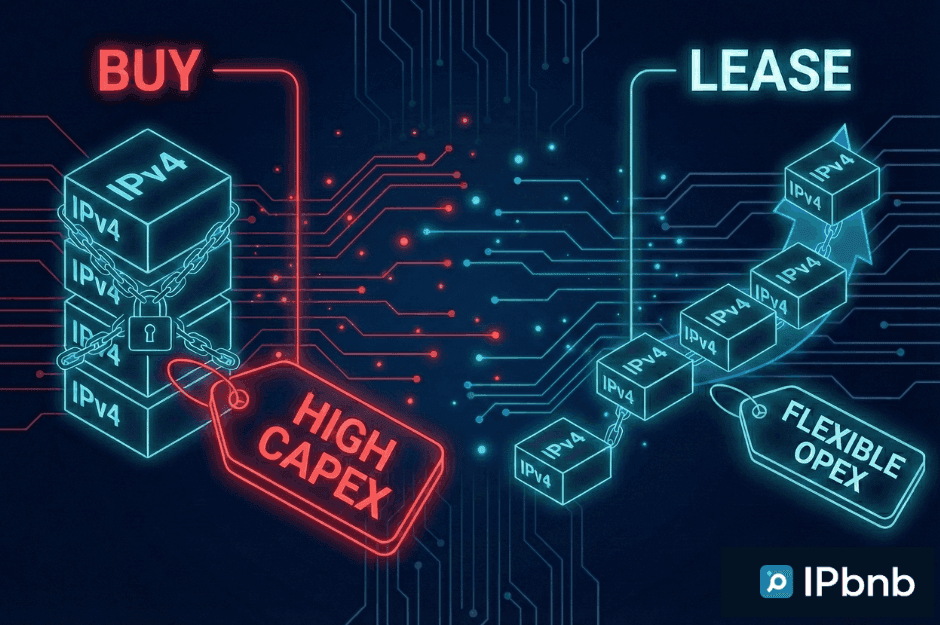
Purchasing IPv4s is a capital expenditure (CapEx) that ties up funds which could be better spent on growth - whether that's developing new products, scaling marketing, or hiring talent. Leasing, by contrast, keeps your cash flow healthy and your resources focused on what actually moves the business forward.
This approach also shines when:
You're running short-term projects - such as temporary platforms, event services, or campaigns - and don't want to pay for ownership you'll soon stop using.
You're testing new markets - leasing lets you rent IPs regionally without long waits for registry transfers or complex approvals.
You have seasonal or fluctuating demand - extra IPs during peak periods without long-term commitments. Before you sign a lease, review the five common leasing mistakes to protect yourself.
You're uncertain about the future - leasing buys you time to validate your model before locking into ownership.
For example, a SaaS startup once leased a /22 block (1,024 IPs) for six months to support a sudden surge in users. Internal approvals for buying would have taken weeks, but leasing got them online in just two days. By the time the project stabilized, they had a clearer picture of their infrastructure needs.
Key takeaway:
The IPv4 leasing market in the RIPE region is long past the experimental stage. Since RIPE NCC exhausted its pool in 2019, waiting for a single /24 can take up to two years - so consistent leasing demand is no surprise.
Financially, leasing often makes more sense in the short term. In 2026, purchase prices sit around $35-45 per IP ($9K-11.5K for a /24), while leasing typically costs $0.50-1.50 per IP per month ($128-384 per month for a /24). With a break-even window of roughly 2-4 years, leasing becomes the obvious choice for shorter projects, early-stage teams, or any temporary infrastructure need.
When IPv4 Buying Is the Smarter Move
Buying IPv4 blocks becomes the better option when your organization is in it for the long run. Ownership brings stability, control, and potential financial benefits:
Stable, predictable usage - If your infrastructure will rely on the same IP space for several years, it's usually cheaper in the long term to buy IPv4 blocks rather than lease them continuously.
Building a trusted reputation - Consistent use of the same IP space is crucial for maintaining good email deliverability, hosting reliability, and network trust. Owning your addresses helps you build and protect a clean IP reputation over time.
Regulatory and compliance needs - In industries where security audits and documentation are critical, IP ownership simplifies compliance and reduces operational dependencies on third parties.
Asset value - IPv4 addresses are finite. Market prices have remained relatively strong over the years, and owning a clean block can be a strategic investment. The IPv4 address buy price you pay today could translate into a valuable asset tomorrow, especially if demand stays high.
Leasing and buying aren't competing strategies - they're simply designed for different business needs and timelines. Leasing is ideal when you need to move fast, stay flexible, or keep your options open. Buying, on the other hand, pays off when stability, control, and long-term value matter most. Once you understand where your organization fits on that spectrum, the choice becomes much clearer.
Operational Considerations Beyond Cost
Whether you buy or lease IPv4 addresses, a few operational factors can have just as much impact as price. Ignoring them can lead to delays, compliance issues, or reputation problems down the line.
Routing authentication - Modern networks increasingly rely on RPKI to prove who's authorized to announce an IP prefix. It's far more secure than traditional LOAs (Letters of Authorization) and helps prevent route hijacking.
Abuse and reputation management - A clean IP block is a valuable asset. Regular monitoring during use and proper post-lease hygiene help keep it that way, protecting both owners and renters.
Policy rules - Each regional internet registry has its own regulations. For example, in RIPE NCC regions, you must hold a block for 24 months before transferring it again. Understanding these timelines is essential for planning future moves.
Automation - Modern platforms reduce friction by automating LOA issuance, routing updates, and reputation checks, making both leasing and buying more efficient and less error-prone.
All these steps can get complicated - especially if you handle them manually. That's why IPbnb automates the entire process.
The platform manages routing authentication through verified authorizations, monitors IP reputation in real time, and automatically enforces regional policies. Owners stay protected and retain full control of their subnets, while renters get clean, ready-to-use IPs with clear, transparent terms.
In short, IPbnb does the heavy lifting - so your team can focus on scaling, not paperwork.
How Teams Combine Leasing and Buying
For many organizations, the decision isn't strictly buy vs. lease - it's often a mix of both. A hybrid approach gives teams the stability of ownership while keeping the flexibility to scale when needed.
For example:
A company might buy a core IPv4 block to support its long-term infrastructure.
During traffic spikes, product launches, or expansion into new regions, it leases additional space temporarily.
Some teams lease first, then buy IPv4 addresses later once a project proves its long-term value.
There's also an in-between option: leasing with the right to purchase. This works well when you need to secure a specific network but don't have the budget to buy it outright - or when there's still uncertainty about future demand. It lets you lock in the addresses you need today while preserving flexibility for tomorrow.
At IPbnb, we're open to custom lease-to-own offers, helping teams structure deals that match their financial strategy and growth stage.
This blended model allows businesses to grow at their own pace - without overcommitting upfront or facing capacity shortages when demand surges.

Bringing It All Together
There's no single right answer to the lease IPv4 vs buy IPv4 question. The right approach depends on your time horizon, budget, and operational priorities. Leasing IPv4 space gives you speed and flexibility when you need to scale quickly. Buying IPv4 blocks gives you control and long-term value for stable, predictable infrastructure.
Many teams combine both strategies - leasing first to move fast, then buying once their needs solidify.
If you choose to rent, the process should be secure, transparent, and efficient. That's exactly where IPbnb comes in. The platform connects IP owners and renters in a trusted marketplace built for both sides:
For holders: List your blocks, earn monthly revenue, and keep ownership.
For renters: Rent trusted IP space quickly, with automated routing and reputation monitoring.
With IPbnb, you keep control, stay compliant, and avoid the delays of manual negotiations. Talk to an expert or estimate your earnings to see how IPbnb can support your strategy!
FAQ & Glossary
What is IPv4?
Internet Protocol version 4 (IPv4) is the original addressing system for the internet. Each IP is like a unique "street address" for a device or server.
What is RPKI?
Resource Public Key Infrastructure - a security system that uses cryptographic signatures to prove who is authorized to announce (route) an IP prefix.
What is a LOA?
Letter of Authorization - a document from the IP owner granting permission to route their IP space. Common in leasing, though less secure than RPKI.
What is ARIN?
American Registry for Internet Numbers - the organization managing IP allocations in North America.
What is RIPE NCC?
Réseaux IP Européens Network Coordination Centre - the regional internet registry for Europe, the Middle East, and parts of Central Asia.
What is APNIC?
Asia-Pacific Network Information Centre - the registry that distributes and manages IP resources across the Asia-Pacific region, including Australia, New Zealand, China, Japan, and many Pacific island nations.
What is AFRINIC?
African Network Information Centre - the registry that manages IP address allocations for Africa and the Indian Ocean region.
What is LACNIC?
Latin America and Caribbean Network Information Centre - the registry responsible for Latin America and most Caribbean countries.
What is CapEx vs. OpEx?
CapEx (Capital Expenditure) = buying assets (like IPs) upfront. OpEx (Operational Expenditure) = ongoing monthly expenses (like leasing).
What is "IP reputation"?
A measure of how trustworthy an IP address is, often based on past behavior (spam, abuse, etc.). Clean reputation is essential for hosting, email, and security.