


How IPv4 Leasing Works: Inside the Technical Workflow
Learn how IPv4 leasing actually works under the hood: RIR objects, LOA, RPKI, routing, abuse, and billing flows. See where IPbnb fits in and how to start safely.

Artem Kohanevich
Co-Founder & CEO at IPbnb
Last updated
Table of Contents
item
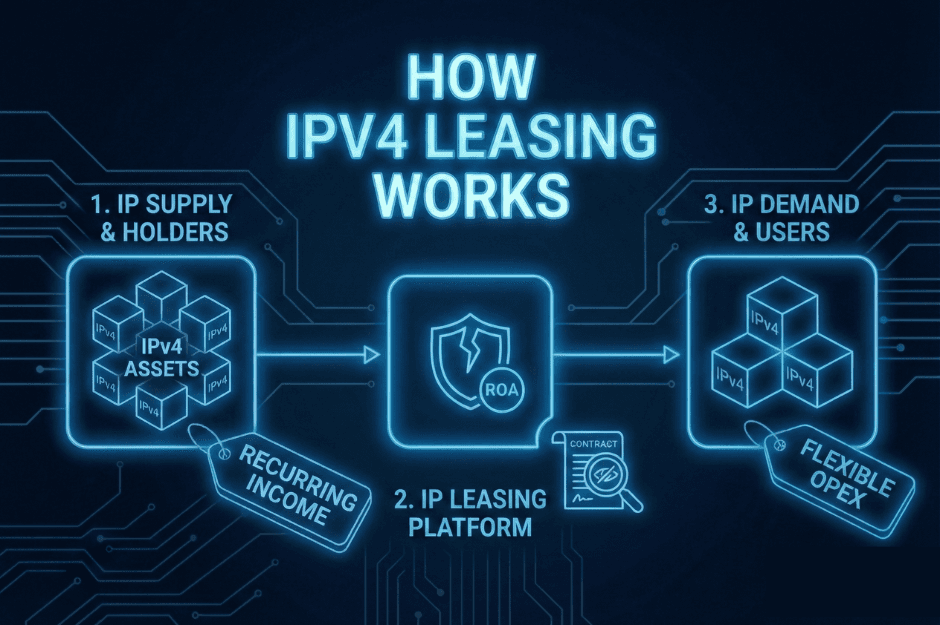
An IPv4 lease allows organizations to route, announce, and use an IPv4 subnet for a fixed period without purchasing the address space outright. Most IPv4 leasing failures aren't scams – they're simply the result of not fully understanding how the process works. The moment you try to announce someone else's space, all the hidden dependencies start to surface: routing filters, missing or invalid ROAs, stale WHOIS records, and the usual RIR quirks that nobody remembers until something breaks.
IPv4 scarcity has also reshaped the market behind the scenes. To lease IPv4 today isn't as simple as "find a block, pay monthly, done." It touches everything from RIR bureaucracy and IRR objects to RPKI, routing policies, LOA approvals, geolocation updates, and basic abuse-desk hygiene.
That's why we prepared this guide: to break down the full IPv4 leasing chain – from ownership to announcement – in a way you could sketch on a whiteboard in a couple of minutes. You'll see where issues usually appear and how platforms like IPbnb remove most of the friction.
Complete guide to IPv4 leasing: how it works, costs, and what to check before you sign. If you're evaluating providers, our guide on how to choose the best IPv4 leasing provider covers the 10-point checklist.
When to Dive Into the Mechanics of IPv4 Leasing
Why should you care about what's happening under the hood of IPv4 leasing? The simple answer: to avoid losing money, time, and reputation.
This knowledge is essential for anyone working with traffic at scale – network engineers, infrastructure leads, DevOps teams, hosting providers, ad-tech and scraping platforms, email delivery teams, and CTOs responsible for routing and capacity decisions. If that sounds like your world, you're in the right place.
IP leasing becomes important at very specific moments in your infrastructure lifecycle. You start thinking about it when entering new regions and need a local footprint – or when your current geolocation doesn't reflect where your users actually are. It matters when you're dealing with rapid user growth, sudden traffic spikes, or a migration between data centers or cloud providers.
You'll also encounter IPv4 leasing when building a hybrid model that blends owned and rented space, or when you need short-term capacity: ad-tech surges, VPN endpoints, scraping workloads, email warmup, or new PoPs you want to test before committing. And for many teams, it's simply the practical option when they don't want to sink capital into high-priced IPv4 purchases.
If any of this sounds familiar, learning how to lease IPv4 cleanly and predictably will save you from the pitfalls that often catch teams off guard.
What Is an IP Address Lease?
What is an IP address lease? An IP lease is a contract that grants temporary use of an IPv4 subnet to an organization, giving them the right to route and announce that address space from their own ASN for the duration of the agreement. Ownership of the block stays with the original holder throughout - only operational control is transferred.
When you lease an IPv4 block, you get routing rights, administrative delegation through IRR objects and ROAs, and typically an LOA that satisfies your upstream provider's requirements. What you don't get is title to the resource - the RIR records continue to reflect the original owner.
Is renting IPv4 the same as leasing? Yes - "rent IPv4" and "lease IPv4" describe the same arrangement. The terms are used interchangeably in the market, though "lease" is more common in formal contracts and platform documentation because it better reflects the fixed-term, documented nature of the agreement. Whether you're looking to rent IPv4 for a short project or lease IPv4 address blocks long-term for stable infrastructure, the underlying mechanics are identical.
What Really Happens When You Lease IPv4 Space
Under the hood, an IPv4 lease is a coordinated chain across registries, routing, and reputation systems – and each part has to line up before a prefix is considered legitimate on the global internet.
Here's the short version of what's actually happening:
Ownership never leaves the holder. You're renting the right to route the subnet, not buying the asset itself.
Delegation is operationally established through IRR objects, ROAs, and LOAs. RIR databases reflect ownership, not the lease itself (except RIPE/APNIC sub-allocations). These confirm who controls the prefix and which ASN is allowed to announce it.
RPKI/ROA ties everything together. A ROA is recommended and widely validated, but RPKI adoption is not universal. Without a matching ROA, you risk rejection by networks that enforce origin validation.
You originate the prefix via BGP. Once delegation is in place, your network announces the block and upstreams propagate it globally.
Reputation and abuse handling are ongoing. Spam reports, SMTP blocklists, previous misuse, stale WHOIS details, and geolocation drift all influence how the prefix behaves once live. See our IP reputation tools and best practices guide for the full checklist.
Platforms like IPbnb streamline the entire chain. They automate IRR updates, ROA creation, LOA delivery, abuse workflows, reverse DNS delegation, invoicing, and lease lifecycle management.
A useful way to think about IPv4 leasing is as three layers that all need to stay aligned:
Commercial layer: Contracts, pricing, duration, renewal logic, AUP, SLAs, and financial safety.
Administrative layer: RIR details, WHOIS/ORG-ID accuracy, IRR route objects, RPKI/ROA configuration, and geolocation updates. LOAs are required by some transit providers, especially where policy or legacy filters apply.
Routing layer: BGP announcement, prefix propagation, upstream acceptance, rDNS, filtering policies, latency, and operational monitoring.
If any of these layers is misaligned – wrong ROA, outdated IRR object, incomplete LOA, or a prefix with bad reputation – your announcements may fail, flap, or get blocked by upstreams, RBLs, or geolocation services.
What IPv4 Leasing Actually Is (and What It Definitely Isn't)
Formal Definition and Key Participants
An IPv4 lease is the process where the IP owner grants another party the right to route, announce, and use an IPv4 subnet for a fixed period of time.
The critical point: ownership never transfers. The holder keeps full legal title to the resource; the lessee only receives operational control.
A complete IPv4 leasing workflow usually involves several actors:
IP Owner – the organisation that legally owns the IPv4 block according to RIR records.
Lessee – the organisation using the prefix for their infrastructure, services, or traffic.
IPv4 Leasing Platform (e.g., IPbnb) – automates validation, contracts, LOA flow, IRR/RIR checks, ROA creation, abuse workflows, and billing.
RIRs (RIPE, ARIN, APNIC, LACNIC, AFRINIC) – the regional registries that maintain authoritative ownership and allocation records.
Transit / Upstream Providers – the networks that propagate your BGP announcements and enforce IRR/RPKI filtering.
Abuse Desks & RBL Ecosystem – entities that monitor IP reputation, blocklist activity, spam signals, malware behaviour, and previous abuse.
IP leasing is best understood as a legal and administrative delegation – not a sale, not a transfer, and not co-ownership. The owner retains their resource; the lessee temporarily receives routing rights under a defined contract and AUP.
What IPv4 Leasing Is Not (Common Confusion Explained)
Many engineers first encounter the term "lease" in the context of DHCP, which leads to a widespread misconception.
DHCP Lease vs IPv4 Lease – Completely Different Worlds
Aspect | DHCP Leasing | IPv4 Leasing |
|---|---|---|
Scope | Inside a private network | Internet infrastructure level |
What's assigned | One IP address to a device | Entire routed subnet (/24, /23, /22, etc.) |
Duration | Minutes, hours, or days | Months or years |
Requirements | No RIR records, no BGP, no contracts | LOA, IRR route objects, RPKI/ROA, BGP, legal agreements |
Aside from the word "lease," the two processes have nothing in common. Confusing them leads to operational mistakes – especially for teams new to routing or RIR workflows.
The Three Planes of IPv4 Leasing
The easiest way to understand an IPv4 lease is to look at it as something that happens across three different "planes" of work. Each one shapes how a leased prefix behaves long before it ever appears in a routing table. When they line up, the lease feels predictable and boring – which is exactly what you want. When one of them is off-balance, everything from routing to reputation can start to wobble.
1. The Commercial and Legal Plane
Every IPv4 lease begins long before anyone touches a router. Two parties – the owner of the address space and the organisation that wants to use it – need a clear agreement about what's being rented, for how long, and under which conditions. This is where questions about price, contract duration, the acceptable-use policy, renewal terms, and responsibilities are sorted out. It's also the plane where abuse handling is defined, because reputation problems never stay theoretical; they always land on somebody's desk.
On traditional brokered deals, all of this is handled through emails, PDFs, and manual reminders. Platforms like IPbnb take over the mechanical work so the human parts of the agreement stay simple. Contract generation, recurring billing, payout scheduling, renewal notifications, and basic SLA enforcement move from spreadsheets into one predictable flow. Nothing about this plane touches the technical stack yet – but the stability of everything that comes later depends on getting this part right.
For holders looking to list their addresses, here's a step-by-step guide to listing on IPbnb.
2. The Administrative Plane: RIR Records, IRR Objects, LOA, and RPKI
Once the paperwork is in place, the real complexity begins. To lease an IPv4 block on the global internet means telling several systems – some older than many of the engineers working today – who is supposed to be routing the prefix.
It starts with the RIR records, which need to reflect accurate ownership and contact details. From there, the focus shifts to the IRR databases. The route objects in IRR signal to transit providers that a given ASN is permitted to originate the prefix. If these objects still contain references from a previous lease, an outdated maintainer, a mismatched CIDR size, or the wrong upstream, announcements can be dropped silently. It's a part of the ecosystem where small inconsistencies create surprisingly large operational problems.
Next comes the LOA, a simple but essential document that tells upstream networks they should accept your announcement. Some providers won't touch a prefixed route without a valid LOA, and others will only accept one that matches their exact formatting expectations.
Then there is RPKI. A correct ROA is the modern stamp of legitimacy. If it lists the wrong ASN, the wrong maximum prefix length, or an expired validity window, your announcement may be marked as "invalid" and rejected by any network enforcing origin validation. This is one of the most common sources of confusion for teams new to IP leasing: everything looks fine on their router, but the global routing table disagrees.
Skipping RPKI is one of the five most common IPv4 leasing mistakes – and one of the most expensive.
All these records – RIR, IRR, LOA, ROA – form the administrative backbone of the IPv4 lease. When aligned, they unlock the routing plane. When out of sync, they create the kind of troubleshooting sessions nobody wants to run at 2 a.m.
3. The Routing and Operational Plane
Only after the legal and administrative work is aligned does the prefix move into its active life. At this point, the lessee announces the subnet from their ASN, and upstream providers decide whether to accept the route. This decision is influenced by everything prepared earlier: the IRR objects, the LOA, the ROA, and how cleanly the prefix has been handled in the past.
Once the prefix is live, the day-to-day operational responsibilities begin. Reverse DNS needs to reflect the lessee's infrastructure; geolocation databases often need correction because they might show the block in a completely different region; and the prefix's reputation must be watched closely, especially in environments sensitive to email delivery, VPN traffic, or ad-tech workloads. Abuse desks continue to play a role throughout the IPv4 lease, because even a small spike in unwanted traffic can put the block on someone's radar. Traffic anomalies, routing leaks, and hijack attempts also have to be watched, as leased space sometimes attracts more attention than owned space.
This plane is where everything becomes real. The prefix is no longer an entry in a contract or an object in a registry — it's a live part of the internet. How smoothly it behaves depends on the work done in the previous two planes.
Plane Responsibilities: Summary Table
Plane | Key Artifacts | Who Owns It | Typical Issues |
|---|---|---|---|
Commercial & Legal | Contract, SLA, Billing | Owner + Lessee + Platform | Unclear abuse responsibility |
Administrative | RIR objects, IRR route objects, LOA, ROA | Owner or Platform | Stale objects, invalid ROAs |
Routing & Operational | BGP, rDNS, geolocation, RBL status | Lessee | Dirty IPs, poor geolocation, leaks |
How IP Leasing Works Step by Step
Whether you're leasing a /24 for email warmup or a /20 for a new regional PoP, the workflow follows the same sequence. Here is how IP leasing works in practice, from the moment you identify a block to the moment your prefix is live and monitored.
Step 1 - Select and validate a block. When you lease an IPv4 block, you or the platform checks it for blacklist entries, RPKI status, IRR object accuracy, and any reputation history that could create problems after announcement. Dirty blocks or blocks with invalid ROAs need remediation before they're useful.
Step 2 - Sign the lease agreement. The contract defines price, duration, renewal terms, acceptable use, and abuse responsibilities. On platforms like IPbnb this is generated automatically; on direct deals it's handled manually between owner and lessee.
Step 3 - Administrative delegation. The owner (or platform) updates IRR route objects to point to your ASN, issues an LOA, and creates or updates the ROA. For RIPE and APNIC, a sub-allocation or delegated assignment is created under your ORG-ID. For ARIN and LACNIC, a reassignment record is created.
Step 4 - BGP announcement. You configure your router to originate the prefix and your upstream providers propagate it. Most teams test reachability from multiple vantage points (RIPE Atlas, BGPView, Hurricane Electric) before considering the prefix fully live.
Step 5 - Geolocation and rDNS. Geolocation databases often show the block in the wrong region after a new lease. Platforms batch-update major databases; expect 3-10 days for MaxMind and DB-IP, and 2-6 weeks for CDNs and ad-tech ecosystems. Set up reverse DNS to reflect your infrastructure.
Step 6 - Ongoing monitoring. Reputation, routing stability, and abuse signals need watching throughout the lease. When you lease IPv4 address blocks for production traffic, an undetected blacklist entry or routing leak can cause real business impact quickly.



Under the Hood: From IP Owner to Your ASN
Scenario 1 – Direct Leasing via RIR Sub-Allocation / Reassignment
Depending on the RIR, the owner delegates the prefix using one of two mechanisms:
RIPE NCC & APNIC: Create a sub-allocation / delegated assignment under your ORG-ID.
ARIN & LACNIC: Create a reassignment (not a sub-allocation). Note: ARIN/LACNIC require operational justification, as their policies do not formally recognize leasing; the record simply shows that your organization is using the space.
AFRINIC: Delegation is technically possible but policy enforcement is inconsistent due to ongoing governance issues.
Once the appropriate RIR record is in place, the owner (or their maintainer) performs the remaining steps:
Updates or creates IRR route objects pointing to your ASN
Issues an LOA, if your upstream requires one
Creates or updates a ROA (if RPKI is enabled for that prefix) to authorize your ASN (If the block has no RPKI yet, ROA creation first requires enabling a trust anchor at the RIR.)
This method provides strong administrative control and direct transparency, but it requires manual coordination, correct RIR policy handling, and familiarity with IRR/RPKI workflows.
Scenario 2 – Leasing via Marketplace (IPbnb)
Owner imports the prefix into IPbnb → IPbnb:
Validates ownership
Cleans IRR objects
Issues route objects automatically
Manages ROAs
Generates LOA on demand
Handles billing and abuse
Lessee only needs ASN + routing details.
Comparison Table
Step | Direct Leasing | Leasing via IPbnb |
|---|---|---|
RIR/IRR updates | Manual | Automated |
ROA management | Owner/lessee | Platform |
LOA | Manual | Instant |
Time-to-live | Hours–days | Minutes |
Risk of errors | Medium–high | Low |
Choosing an IPv4 Lease Provider
Not all IPv4 lease providers operate the same way, and the difference matters the moment something goes wrong. Here is what to evaluate before committing to a provider.
Automation depth. When you lease an IPv4 block through a well-built platform, IRR updates, ROA creation, and LOA generation happen automatically. Providers that handle this manually introduce delays and error risk at the most critical points in the workflow.
Reputation verification. A reputable IPv4 lease provider checks every block against major blacklists, spam-trap networks, and threat intelligence feeds before onboarding it - and monitors continuously during the lease. Ask specifically what checks are run and how quickly abuse is actioned.
RIR compliance. The provider needs to handle RIR-specific delegation correctly: sub-allocations for RIPE and APNIC, reassignment records for ARIN and LACNIC. Providers that use a one-size-fits-all approach tend to create compliance problems that surface later.
LOA handling. Your upstream may have specific LOA format requirements. A good IPv4 lease provider generates LOAs that meet major transit provider standards, and reissues them quickly if your upstream or routing setup changes.
Lease flexibility. Look for providers that offer multiple term lengths (monthly, quarterly, annual) and clear renewal and termination terms. When you lease IPv4 addresses for infrastructure that may scale or shift, flexibility in contract structure matters as much as the price per IP.
Support responsiveness. Routing problems and reputation incidents don't keep business hours. Evaluate whether the provider offers meaningful technical support, not just a ticketing system.
For a full 10-point evaluation framework, see our guide on how to choose the best IPv4 leasing provider.
Where IPbnb Fits in the IPv4 Leasing Landscape
IPbnb is a B2B IPv4 leasing platform built for transparency, security, and automation. It brings:
RIPE/ARIN expertise built into the workflow
Automated IRR, ROA, and LOA
Verified clean IP space
Fast onboarding and predictable routing
A safe marketplace for owners and lessees
If you're tired of the grey market and want something predictable – start with a /24 pilot.
Check current rates with our IPv4 pricing calculator.
Next Steps: Bringing IPv4 Leasing Into Your Infrastructure
By now, you've seen how an IPv4 lease works behind the scenes – from contracts and registry updates to routing behaviour and reputation. The next question is simple: what does adopting IP leasing look like in practice?
If you're on the lessee side, it starts with understanding your demand. Most teams map out how much space they need, which regions matter, and which ASNs will originate the prefixes. A small pilot is usually enough to test the full workflow. Many organisations begin with a single /24 to see how it behaves in their routing setup, how geolocation adjusts, and how quickly the administrative pieces fall into place. A week is often enough to feel confident.
If you're an IP owner, the path begins with an audit of your records: checking RIR and WHOIS accuracy, verifying that the block has no hidden reputation issues, and clearing out old IRR or ROA entries. Once everything is clean, listing unused space is straightforward, and those addresses can finally start generating stable income instead of sitting idle.
Whether you're leasing IPv4 addresses or putting your assets to work, the process doesn't need to be complicated. IPbnb was built to make both sides predictable and quick to onboard. Start leasing clean IPv4 on IPbnb.
FAQ: Engineers' Most Common Questions About IPv4 Leasing
Is renting IPv4 the same as leasing?
Yes. "Rent IPv4" and "lease IPv4" refer to the same arrangement - a fixed-term contract granting operational use of an IPv4 subnet without transferring ownership. The distinction is largely terminological: "rent" is more common in casual conversation and shorter-term arrangements, while "lease" appears more often in formal contracts, platform documentation, and RIR-adjacent contexts. Whether you're looking to rent IPv4 for a temporary project or lease an IPv4 block for production infrastructure, the mechanics - IRR objects, ROA, LOA, BGP announcement - are the same.
Who is responsible for creating ROAs and IRR objects?
In a direct, one-to-one lease, the owner usually handles all registry-side work: IRR route objects, maintainer updates, and the ROA that authorises your ASN. If the owner has RPKI enabled, they update or create a ROA. If RPKI is not enabled on that block, ROA creation may require additional steps at the RIR.
In the platform model, most of this is automated. The owner registers their space once; the lessee simply provides their ASN. The platform then creates or updates the correct IRR objects, generates the ROA with the correct max-length settings, and issues the LOA your upstream will expect.
What happens if the leased IPs end up on a blacklist?
Reputation follows the current user, not the owner. If traffic from your infrastructure triggers blocklists or abuse reports, you're expected to fix the underlying issue – whether it's a compromised server, an email misconfiguration, or an ad-tech provider pushing too aggressively.
Good leasing platforms run pre-lease checks across common RBLs, spam-trap networks, and threat feeds to avoid handing out "dirty" space. They also monitor behaviour during the lease, since reputation issues affect both sides. In serious cases (e.g., persistent abuse), the platform may suspend the lease to prevent long-term damage to the prefix.
What use cases are allowed?
This differs between owners and platforms, but in general:
VPN and proxy traffic is usually accepted but often monitored closely.
Scraping and crawling are permitted as long as they follow the AUP and stay within normal traffic patterns.
Email is allowed only with warming policies and clean sending practices; some providers explicitly disallow bulk mail.
Ad-tech workloads are common, as long as traffic doesn't trigger fraud or malware flags.
The key principle: the AUP defines the boundary. If your workload can generate reputation issues, clarify it before signing the lease.
What happens at the end of the lease?
The operational side is straightforward. You withdraw the prefix from your ASN, clean up route maps and inbound filters, and remove any reverse DNS entries.
On the administrative side, the platform or owner revokes the LOA, removes or updates the IRR objects, and adjusts the ROA so your ASN is no longer authorised to originate the block.
A prefix that still has a stale ROA pointing to the lessee's ASN is a common problem after manual leases. Automated workflows help prevent this.
Can I move the leased IPs between different data centers or transit providers?
Yes – as long as:
You control the ASN announcing the prefix, and
Your new upstream provider accepts the LOA issued by the owner or platform.
This flexibility is one of the main reasons teams choose leasing. During a migration, you can temporarily announce the same prefix from two sites, run traffic tests, or shift load gradually. Just remember that geolocation databases may show old regions for a while, so plan for some lag if your workload depends on accurate GeoIP.
How long does geolocation correction take?
Geolocation convergence takes 3–10 days on major DBs (MaxMind, DB-IP) but 2–6 weeks on CDNs, Google services, and ad-tech ecosystems. Platforms often batch-update major databases to speed this up.