


Becoming a RIPE NCC Member: Costs, Benefits, Pitfalls in 2026
RIPE NCC membership sounds like the fastest path to IPv4 – until you see the 12-24 month waiting list. Here's the full cost breakdown, hidden pitfalls, and smarter alternatives for 2026.

Artem Kohanevich
Co-Founder & CEO at IPbnb
Last updated
Table of Contents
item
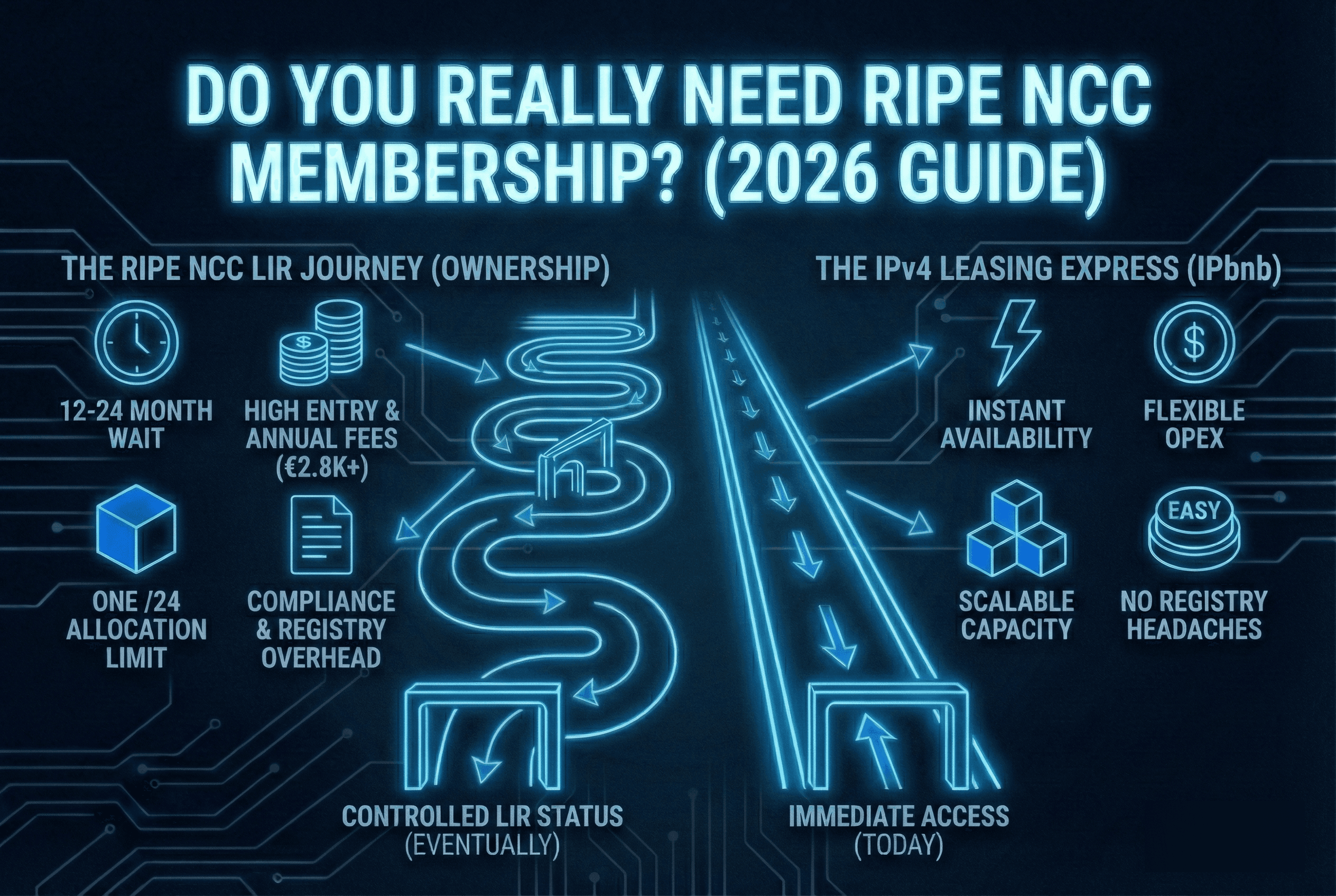
When IPv4 addresses are trading at $35-50 per IP and your business needs clean, routable address space, the thought crosses your mind: "Should we just become a RIPE NCC member and get our own /24?"
It sounds straightforward. Pay the fee, get the IP space, problem solved.
But here's the reality check: in 2026, RIPE membership isn't the simple path to IPv4 it once was. The waiting list stretches 12-24 months, RIPE fees have climbed to €1,800 annually, and you'll only receive one /24 allocation (256 addresses) after all that time and investment.
This guide cuts through the complexity. You'll understand exactly what RIPE NCC membership fees cost in 2026, what membership actually delivers, and when alternatives like IPv4 leasing or managed LIR services make more financial sense. By the end, you'll know whether opening your own LIR is the right move or an expensive detour.
Who Actually Needs RIPE NCC Membership (and Who Doesn't)
Not every organization needs to become a RIPE NCC member. The decision comes down to your business model, resource requirements, and operational capacity.
You're a strong candidate for your own LIR if you:
Operate as an ISP, hosting provider, or telecom with hundreds or thousands of customers under your network
Need regular access to IPv6 allocations and ASN assignments for network expansion
Require direct relationships with RIPE NCC for policy compliance and registry operations
Plan to act as a sponsoring LIR for clients or partners
Have the administrative capacity to handle registry compliance, documentation, and due diligence
You probably don't need your own LIR if you:
Run a SaaS platform, VPN service, ad-tech operation, or proxy network with modest IP requirements
Need IPv4 space quickly (waiting 12-24 months isn't viable for your business)
Lack dedicated staff for RIPE compliance, database management, and policy tracking
Operate project-based or temporary infrastructure where flexibility matters more than ownership
Simply want access to clean IPv4 blocks without the administrative overhead
Red flags that you're not ready for LIR ownership:
You need more than one /24 of IPv4 immediately (RIPE only gives one allocation per new LIR)
Your primary goal is acquiring IPv4 as an investment rather than operational use
You're uncomfortable with annual recurring costs that increase over time
Your organization lacks experience with BGP routing, RPKI, and internet registry operations
What RIPE NCC Membership and LIR Actually Mean
Let's clarify the terminology because confusion here leads to expensive mistakes.
RIPE vs. RIPE NCC: RIPE (Réseaux IP Européens) is the open community where internet professionals develop policy. RIPE NCC (Network Coordination Centre) is the Regional Internet Registry that implements those policies and manages IP resources for Europe, the Middle East, and parts of Central Asia.
Member vs. LIR: When you become a RIPE NCC member, you can open a Local Internet Registry (LIR) account. The terms are often used interchangeably, but technically you can be a member without being an LIR (though this is rare). Most organizations join specifically to operate as an LIR. You can hold multiple LIR accounts under one RIPE membership, but you'll pay separate RIPE LIR fees for each.
What membership actually provides:
Authority to request IPv6 allocations and Autonomous System Numbers (ASNs)
Eligibility for one /24 IPv4 allocation through the waiting list (if you've never received IPv4 from RIPE NCC before)
Access to the LIR Portal for managing your resources
RPKI services for route origin validation and enhanced security
Training courses, technical support, and policy documentation
Voting rights at RIPE NCC General Meetings
Ability to act as a sponsoring LIR for end-user independent resources
What membership does NOT guarantee: Immediate IPv4 space. The waiting list for that single /24 currently runs 12-24 months, and the turnover is unpredictable. If your business case depends on getting IPv4 quickly, RIPE membership alone won't solve that problem.
RIPE NCC Membership Costs 2022–2026: What You Really Pay
Let's look at the actual numbers, because RIPE NCC fees have been climbing steadily and there are more charges than just the headline membership fee.
RIPE NCC Charging Scheme 2026
The current RIPE NCC charging scheme sets the following official fees:
Fee type | Amount |
|---|---|
Sign-up fee (one-time, per LIR) | €1,000 |
Service fee per LIR: €1,800/year | €1,800 |
Independent resource fee | €75 per assignment |
ASN fee | €50 per assignment |
Historical trajectory: the annual RIPE LIR fees have increased significantly:
2022: €1,400 per LIR
2023: €1,550 per LIR
2024: €1,550 per LIR
2025-2026: €1,800 per LIR
That's a 28.6% increase over four years. The RIPE NCC charging scheme is voted on by members annually, and economic pressures - inflation, operational costs, potential member attrition - have driven fees upward.
RIPE NCC Costs Evolution 2022-2026
Year | Sign-up Fee | Annual Fee per LIR | Independent Resource Fee | ASN Fee |
|---|---|---|---|---|
2022 | €1,000 | €1,400 | €50 | €50 |
2023 | €1,000 | €1,550 | €50 | €50 |
2024 | €1,000 | €1,550 | €50 | €50 |
2025 | €1,000 | €1,800 | €75 | €50 |
2026 | €1,000 | €1,800 | €75 | €50 |
RIPE LIR Fees: Full Breakdown
Beyond the headline numbers, understanding the complete structure of RIPE LIR fees matters for accurate budgeting:
Sign-up fee (€1,000, one-time per LIR): Paid on application. Non-refundable if RIPE NCC rejects your application or if you close the LIR before year-end. If you open multiple LIRs - which some organizations do to receive multiple /24 allocations - you pay this for each.
Service fee per LIR (€1,800/year): The annual membership fee covers access to the LIR Portal, RPKI services, technical support, and voting rights. Billed annually; no prorating if you close mid-year. Two LIRs = €3,600/year in service fees alone.
Independent resource fee (€75 per assignment): Charged for PI (Provider Independent) space, IXP assignments, and legacy resources held under a sponsoring LIR. This fee was increased from €50 to €75 in the 2025 charging scheme and has remained at €75 for 2026.
ASN fee (€50 per assignment): Charged when you receive an Autonomous System Number. See the dedicated section below for details.
RIPE NCC ASN Fees
ASN (Autonomous System Number) fees are a separate line item from the annual service fee. The current RIPE NCC ASN fee is €50 per ASN assignment - unchanged from previous years in the 2026 charging scheme.
Key details for planning:
The €50 fee is a one-time assignment fee, not an annual charge. Once assigned, the ASN does not incur recurring fees beyond your standard annual LIR service fee.
Each LIR can hold multiple ASNs, each incurring a separate €50 assignment fee at the time of request.
32-bit and 16-bit ASNs are priced the same at €50 per assignment.
If you only need an ASN without needing to manage IPv4 or IPv6 allocations directly, a sponsoring LIR arrangement can provide an ASN at a fraction of the full LIR cost. ASN registration through IPbnb costs $299 with the first year of sponsorship included, then $149 per year - against €2,850 for a first-year LIR.
Hidden costs that don't appear on RIPE invoices:
Staff time: Someone needs to handle the application process, manage RIPE database objects, respond to audits, and maintain compliance. For organizations without existing registry experience, this can easily consume 10-20 hours per month.
Compliance overhead: RIPE NCC conducts due diligence checks, sanctions screening, and periodic verification. Documentation mistakes can delay your application or freeze resource transfers.
Policy tracking: RIPE policies evolve. Staying compliant means monitoring policy proposals and understanding how changes affect your operations.
Opportunity cost: If you need IPv4 immediately and you're stuck on a 24-month waiting list, what's the business impact of that delay?
The real first-year TCO: For a new LIR requesting one /24 IPv4 and one ASN:
Sign-up fee: €1,000
Annual fee: €1,800
ASN fee: €50
Total year 1: €2,850 (plus internal staff costs)
Subsequent years: €1,850 minimum (annual fee + ASN fee), assuming no additional resources.
Benefits of Becoming a RIPE Member (Beyond Just a /24)
Despite the costs and limitations, RIPE membership delivers real value for the right organizations.
Direct control over your resources: You own the relationship with RIPE NCC. You can request, transfer, and manage IPv6 allocations, ASNs, and (eventually) your /24 IPv4 allocation according to policy guidelines. There's no intermediary controlling your access or charging markup fees.
Comprehensive service ecosystem: RIPE NCC provides far more than just address allocations:
RPKI services for securing BGP route announcements
Access to RIPE Atlas for network measurement and monitoring
Training courses covering registry operations, IPv6 deployment, and routing security
Technical support for database management and policy questions
Statistical tools and reporting for network planning
Community influence: As a member, you get voting rights at General Meetings where the RIPE NCC charging scheme and board elections are decided. You can participate in policy development processes and working groups. For organizations deeply embedded in internet infrastructure, this community access has strategic value.
Sponsoring LIR capability: Once you're an LIR, you can act as a sponsoring LIR for end users who need independent resources (Provider Independent IPv6 space, ASNs). This can become a value-added service for your customers or partners.
Long-term strategic positioning: For ISPs, hosting providers, and network operators with multi-year growth plans, direct RIPE NCC membership establishes your organization as a legitimate network operator in the eyes of peers, partners, and regulators.
Pitfalls and Gotchas of RIPE Membership in 2026
Now for the uncomfortable truths that catch organizations off guard.
IPv4 membership ≠ immediate IPv4 space: You can become a member today and still wait 12-24 months for your /24 allocation. The waiting list depends on addresses being returned from closed organizations or reclaimed from verification work. That stream is slowing down as RIPE NCC completes most verification activities. If you're joining primarily for IPv4, you need a backup plan for the interim period.
For ISPs, see our solutions for ISPs and telecom operators. For hosting providers: hosting and cloud solutions.
One /24 is your only direct allocation: RIPE policy limits new LIRs to a single /24 IPv4 allocation (256 addresses). If you need more IPv4 space, you'll need to purchase it on the transfer market or lease it from existing holders. The days of receiving multiple allocations directly from RIPE NCC ended years ago.
Sign-up fees are non-refundable: If RIPE NCC rejects your application during due diligence (sanctions issues, documentation problems, suspicious patterns), you don't get that €1,000 back. The same applies if your business circumstances change and you close the LIR before the year ends.
Annual fees must be paid in full: You cannot close an LIR mid-year and get a prorated refund. If you close your LIR in March, you still owe the full annual RIPE LIR fees for that year. If you want to transfer resources away, you must have paid your annual fees in full first.
Compliance requirements are real and evolving: RIPE NCC conducts KYC checks, sanctions screening, and periodic audits. They can freeze your resources or terminate membership if compliance issues arise. You're also responsible for keeping all database records accurate. Errors or outdated information can cause operational problems.
Transfer restrictions and timelocks apply: The /24 you receive from the waiting list comes with a 24-month hold period before you can transfer it. This policy exists to prevent "LIR farming" (opening multiple LIRs just to collect and flip /24s). If your business model involves IPv4 asset management, these restrictions matter.
Multiple LIRs = multiple fees: Some organizations open multiple LIR accounts to receive multiple /24 allocations. While RIPE policy allows this, the RIPE fees stack up: €1,000 sign-up + €1,800 service fee per LIR for each account. The math: two LIRs = €5,600 first year, €3,600 annually thereafter. That's expensive compared to simply buying or leasing the IPv4 you need.
Policy and pricing changes happen annually: Every year at the General Meeting, members vote on the next year's RIPE NCC charging scheme. RIPE fees can increase (as they did from 2022-2025). Policies can change in ways that affect your operations. You have voting rights, but you're also subject to the community's collective decisions.
Alternatives: Sponsoring LIR, Managed LIR, IPv4 Leasing
Most organizations don't need their own LIR. Here's what the alternatives actually look like in 2026.
Sponsoring LIR
A sponsoring LIR is an existing RIPE member that requests and maintains independent resources (PI space, ASNs) on behalf of end users. You get the resources allocated directly to your organization, but the LIR handles the registry relationship.
When to use: You need Provider Independent IPv6 space, an ASN, or IXP assignments but don't want full LIR overhead.
Typical costs: $200-500 setup fee, $300-800 annual sponsoring fee (far less than running your own LIR and paying full RIPE LIR fees). IPbnb's ASN registration and sponsorship runs $299 with the first year included, then $149 per year, with an IPv6 /48 assigned at no extra charge.
Trade-offs: You depend on your sponsoring LIR's relationship with RIPE NCC. If they close or terminate the sponsorship, you'll need to find another sponsor.
Holders can list their addresses on the IPbnb marketplace in under 30 minutes.
Managed LIR services
Service providers handle the entire LIR lifecycle: application, documentation, RIPE database management, compliance, and resource requests. You technically own the LIR, but they operate it for you.
When to use: You need LIR status for business reasons but lack internal expertise or time to manage it yourself.
Typical costs: €1,500-3,000 setup, €800-2,000 annually on top of RIPE fees. Total first-year cost: ~€4,000-7,000.
Trade-offs: You're paying for convenience. The managed LIR provider becomes a critical vendor. Make sure they're reliable and understand RIPE policies thoroughly.
IPv4 leasing platforms
Instead of owning IPv4 space, you lease it from existing holders through marketplace platforms. You get clean, routable IPv4 addresses with BGP announcements, LOAs, and RPKI handled by the lessor or their LIR partner.
When to use: You need IPv4 capacity now, want flexibility to scale up or down, and prefer OPEX over CAPEX. Ideal for SaaS platforms, VPNs, cloud infrastructure, and temporary projects.
Typical costs: As of 2026, IPv4 leasing rates range from $0.38-$0.45 per IP per month globally, with APNIC region commanding premiums above $0.60/IP due to policy restrictions. A /24 (256 IPs) costs roughly $97-115/month, or $1,164-1,380 annually.
Estimate your costs with the IPv4 pricing calculator or your earnings with the IPv4 earnings calculator.
Trade-offs: You don't own the addresses. If the lease terminates, you need to renumber (though most platforms offer renewal terms that provide stability). You need to ensure you're working with reputable platforms that monitor IP reputation and handle abuse properly.
Here's a detailed comparison of buying vs. leasing IPv4 with break-even math.
Comparison Table: Own LIR vs Alternatives
Option | Upfront Cost | Recurring Cost (Annual) | Control Level | Complexity | Best For |
|---|---|---|---|---|---|
Own LIR | €1,000-2,850 | €1,800+ | Full | High | ISPs, hosting providers, telecom operators |
Sponsoring LIR | $200-500 | $300-800 | Medium | Low | Organizations needing PI space or ASNs |
Managed LIR | €1,500-3,000 + RIPE fees | €800-2,000 + RIPE fees | Medium | Low | Companies wanting LIR status without internal expertise |
IPv4 Leasing | $0-500 | $0.38-0.45/IP/month | Low-Medium | Low | Fast-growing businesses, temporary projects, flexible capacity needs |
Decision Framework: Do You Really Need Your Own LIR?
Work through these questions honestly:
1. Do you need regular IPv6 or ASN allocations for network expansion?
If your business model involves continuously requesting new IPv6 space or ASNs for infrastructure growth, direct RIPE membership makes sense. But if you need these resources once or infrequently, a sponsoring LIR is more cost-effective.
2. Do you operate infrastructure serving hundreds or thousands of end customers?
ISPs, large hosting providers, and telecom operators almost always benefit from their own LIR. The control, flexibility, and ability to manage customer assignments justify the costs. Smaller operators might not reach that threshold.
3. Can you commit 3-5 years to maintaining the LIR?
Opening an LIR is a multi-year commitment. If your business is in testing or pivot mode, you'll waste money on RIPE fees for something you might not use long-term.
4. Do you have staff capacity for RIPE compliance and operations?
Someone needs to handle database management, respond to audits, track policy changes, and manage resource requests. If you're a lean team, this burden might be significant.
5. Is IPv4 ownership critical to your business model?
If your business requires owning IPv4 assets (for balance sheet reasons, collateral purposes, or long-term certainty), then buying or receiving allocations makes sense. But if you just need access to clean IPv4 space, leasing delivers that faster and more flexibly.
6. Can you afford to wait 12-24 months for a /24 IPv4 allocation?
If your answer is no, RIPE membership alone won't solve your immediate IPv4 needs.
Decision outcomes:
Yes to questions 1, 2, 3, and 4 → Proceed with your own LIR
Yes to 1 and 5, no to 2-4 → Consider managed LIR services
No to 1, 3, or 4 → Sponsoring LIR for independent resources
No to most questions → IPv4 leasing + partner LIR for routing
Read our complete IPv4 monetization guide for revenue estimates and strategies.
IPbnb Angle: Where a Leasing Platform Fits into RIPE Decisions
Here's where platforms like IPbnb change the equation entirely.
The traditional model was binary: either become a RIPE member and manage everything yourself, or buy IPv4 on the transfer market and figure out routing arrangements with your upstream providers.
Modern IPv4 leasing platforms create a third path that combines the benefits of both approaches without most of the drawbacks.
How the ecosystem works: RIPE NCC → LIR Members → IPv4 Leasing Platform → Lessees
IPv4 holders (who are RIPE members with their own LIRs) list their unused address space on platforms like IPbnb. Organizations needing IPv4 capacity can access this space through standardized leasing agreements, with the platform handling:
Matchmaking between lessors and lessees
RIPE-compliant documentation (route objects, LOAs, proper registry entries)
BGP announcements and RPKI setup through partner LIRs
Reputation monitoring and abuse management
Automated provisioning and renewal
When "no LIR + IPbnb + partner infrastructure" beats owning an LIR:
For lessees (IP capacity demanders):
You need IPv4 space in weeks, not 12-24 months
Your requirements fluctuate (seasonal traffic, testing environments, geographic expansion)
You want clean IPs with reputation monitoring included
You prefer predictable OPEX over large CAPEX and fixed annual fees
You don't need IPv6 allocation authority or ASN management from RIPE directly
For lessors (IP capacity holders):
You have IPv4 space sitting unused but don't want the complexity of direct customer relationships
You want monetization without the compliance headaches of acting as a sponsoring LIR
You need platform-level abuse handling and reputation protection
You want transparency on utilization and market rates
IPbnb's differentiation: Unlike traditional brokers or consultants who focus on one-time transactions, IPbnb operates as an ongoing marketplace platform with:
Automated RIPE-compliant processes built in
Real-time availability and transparent pricing
Integrated reputation monitoring to protect both lessors and lessees
No requirement for lessees to become RIPE members themselves
The hybrid scenario: Some organizations use a hybrid approach: operate their own LIR for core infrastructure and IPv6 allocations, but supplement IPv4 capacity through leasing platforms for:
Geographic expansion into new regions
Temporary projects or proof-of-concepts
Overflow capacity during traffic spikes
Testing clean IP pools without risking owned address space
RIPE NCC membership in 2026 is the right choice for ISPs, hosting providers, telecom operators, and organizations with ongoing needs for IPv6, ASNs, and direct registry relationships. But for many businesses, especially those primarily needing IPv4 capacity, alternatives like IPv4 leasing deliver faster results, lower complexity, and comparable costs without the multi-year commitment and administrative burden.
Don't let the allure of "getting a /24 from RIPE" drive a decision that costs you time and money. Understand your real requirements, model the true TCO including hidden costs, and choose the path that serves your business—not just the one that sounds most impressive.
FAQ: RIPE NCC Membership & LIR
If I only need one /24 of IPv4, do I have to become a RIPE NCC member?
No. You can lease a /24 from existing holders through platforms like IPbnb, often within days and at comparable or lower annual cost than RIPE membership fees. You can also buy a /24 on the transfer market through brokers, though this requires RIPE membership to register the transfer.
Can I start with sponsoring LIR and later open my own LIR?
Yes, absolutely. Many organizations begin with a sponsoring LIR arrangement to get independent resources (IPv6 PI space or an ASN), then transition to their own LIR as they scale. The resources can be transferred to your new LIR once it's established.
What happens to my LIR if my company goes through M&A or liquidation?
RIPE NCC has specific procedures for mergers, acquisitions, and closures. For mergers, LIRs and their resources can be consolidated under due diligence. For closures, you must return resources or arrange transfers (paying any outstanding RIPE fees first). If liquidation happens before year-end, you still owe the full annual fee.
Can I close my LIR and what happens to the IPv4 resources?
You can close your LIR account at any time, but you must have paid all outstanding fees first. IPv4 resources must be either returned to RIPE NCC, transferred to another LIR, or converted to independent resources under a sponsoring LIR. The sign-up fee is never refundable, and annual RIPE LIR fees aren't prorated.
What's cheaper over 3-5 years: own LIR vs leasing?
It depends on your needs. If you only need one /24 and have administrative capacity, your own LIR can be cheaper long-term (€8,450 over 5 years vs ~$5,820-7,740 for leasing). But leasing includes zero wait time, no compliance overhead, and flexibility to scale up or down. For anything beyond one /24, leasing or purchasing additional space becomes necessary anyway, changing the math significantly.
Do I need separate RIPE membership for different legal entities in my corporate structure?
Each legal entity needs its own RIPE membership and pays separate fees. However, you can hold multiple LIR accounts under a single legal entity (paying the service fee per LIR for each). The structure depends on your corporate setup and operational requirements.
What risks should I know about when leasing IPv4 instead of owning?
The main risks are lease termination (requires renumbering), dependence on the lessor's LIR relationship with RIPE, and potential reputation issues if the platform doesn't properly monitor abuse. Mitigate this by choosing established platforms with strong abuse handling, clear renewal terms, and geographic diversity in their IP pools.