


Monetize Your IPv4 Blocks: A Practical Guide for 2026
Turn IPv4 addresses into revenue. A complete owner's guide to IP address monetization, leasing options, market values, and compliance requirements.

Artem Kohanevich
Co-Founder & CEO at IPbnb
Last updated
Table of Contents
item
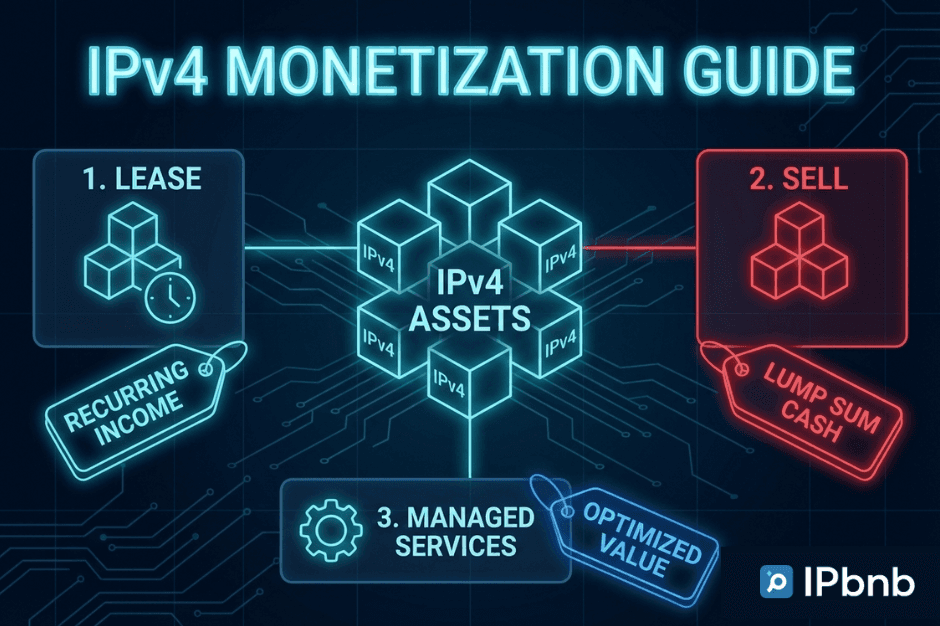
Learn how to monetize IPv4 addresses through leasing or selling - and turn idle network inventory into a predictable revenue stream. Your unused IPv4 addresses may be worth $30,000 to $300,000+ in passive income.
What used to be a forgotten line in your network inventory can now become a steady revenue stream. If you want to monetize IP address blocks, this guide covers everything from valuation and pricing to platform selection and compliance.
For years, organizations that completed cloud migrations, merged with other entities, or restructured IT operations have been sitting on legacy IPv4 allocations they no longer use. What most don't realize is that these idle addresses can be leased to data centers, cloud providers, and network operators facing ongoing IPv4 shortages – and the market is willing to pay.
After the global pool of 4.3 billion IPv4 addresses was exhausted in early 2011, demand only intensified. In 2025, smaller address blocks trade around $25–$30 per IP, while larger blocks settle around $16–$20 per address following a 2024 correction. Despite IPv6 adoption reaching nearly half the global traffic, IPv4 remains critical – and profitable to monetize.
The real opportunity lies in leasing. Current rates generate $0.38–$0.45 per IP monthly ($4.56–$5.40 annually), with premium markets like APAC exceeding $0.60 per month. A small block of 256 addresses earns about $1,200 yearly, while a large enterprise allocation of 65,000+ addresses can generate over $300,000 annually.
Use our IPv4 earnings calculator to estimate your potential revenue.
In this guide, IT directors, CFOs, and university administrators will learn how IPv4 monetization works, how to calculate potential revenue, which platforms to use, and how to mitigate technical and compliance risks.
Demand remains strong in 2026 – and the opportunity is clearer than ever.
Understanding Your IPv4 Asset
The first step toward monetizing IPv4 is knowing what you actually own – and what's still unused. Many organizations hold dormant allocations without realizing their market value.
Do You Have Monetizable IPs?
You can verify ownership through your Regional Internet Registry (RIR) portal – ARIN, RIPE NCC, APNIC, LACNIC, or AFRINIC – or by performing a WHOIS lookup to see registered ranges, status, and contact details.
Typical cases where unused IPv4 blocks hide in plain sight include:
Legacy allocations from the 1990s–2000s, before stricter RIR policies.
Over-provisioning during periods of rapid growth or network expansion.
Post-merger consolidations, where overlapping address space becomes redundant.
Cloud migration leftovers, where on-prem servers were retired but IPs weren't released.
Key takeaway:
Start with a quick reality check. Open your RIR account and take a look at every subnet your organization owns. You'll probably spot a few that haven't seen traffic in years. Next, separate the active ranges – the ones still routed or announced via BGP – from those that are sitting idle. And before you go any further, make sure you still have the right administrative access to update those records.
What Makes IPv4 Valuable?
IPv4's value stems from permanent scarcity – only 4.3 billion addresses exist, and all are already allocated.
Prices have climbed from around $15–25 per address in 2015 to $20–35 by 2025 for smaller blocks, while larger blocks have seen price corrections, with some trading near $20. The market has shown notable volatility, with periods of rapid appreciation followed by corrections driven by shifting supply dynamics.
Demand remains strong from AI data centers, IoT networks, and cloud providers – industries expanding far faster than IPv6 adoption.
IPv6, though abundant, isn't set to replace IPv4 anytime soon due to compatibility issues with legacy systems, the high cost of infrastructure upgrades, and a dual-stack transition that has already lasted more than a decade and is expected to continue for at least another 10–20 years.
Block Sizes, Liquidity, and Pricing Dynamics
In the IPv4 market, block size matters. Each range behaves almost like a different product.
Smaller subnets such as /24s (256 IPs) are the most liquid – easy to route, quick to deploy, and perfectly sized for most tenants. /20s–/22s also move fast when priced fairly, offering a balance between volume and manageability. At the other end of the spectrum, /16s (65,536 IPs) trade more slowly and usually command a lower per-IP rate because of bulk discounts and a narrower buyer pool capable of absorbing large allocations.
Through 2024–2025, multiple reports show small-block prices converging, while large-block values corrected sharply from their mid-2024 highs – for example, /16s dropping from the $50-per-IP peak to around $20.
Regional Variations
Pricing also varies by region, shaped by scarcity and policy differences.
In 2024, APNIC recorded the highest leasing rates, reaching up to $0.83 per IP per month, while RIPE and ARIN regions held steady around the mid-$0.40s. AFRINIC remained the most affordable. By early 2025, this pattern persisted: small blocks stayed strong, while large blocks continued to see discounts.
The reason is simple – regional depletion timelines and transfer rules. RIPE's free IPv4 pool officially ran out in November 2019, leaving only small wait-list allocations (typically a single /24). As a result, most trading now happens through the transfer and leasing markets, where RIR policies and transfer friction create week-to-week price differences.
For context on what that /24 waiting list actually involves, see our breakdown of RIPE NCC membership costs and pitfalls.
Reputation Quality
An IPv4 block's reputation can make or break its marketability.
Addresses with clean histories – free of spam, abuse, or blacklisting – lease quickly and at a premium. Those with poor reputations may be heavily discounted or temporarily unleaseable until cleaned up. Blacklisted ranges often face email delivery blocks, filtering, and quarantine by security networks like Spamhaus, and remediation takes time and money.
Maintaining a positive reputation requires ongoing hygiene and careful lessee screening. A single bad tenant can damage the entire subnet's value for months.
Read our IP reputation tools and best practices guide for the monitoring stack.
What This Means for Owners
Real-world examples show how these factors work together. A regional ISP monetized a /19 block for nearly $49,000 per year, increasing annual revenue by 30%. Ukrtelecom turned dormant allocations into a steady funding source for network upgrades. Orion Telekom earned about $400,000 from unused space, and several major universities in the U.S. and Europe now generate between $3–30 million annually from leasing their legacy IPv4 holdings.
In short, IPv4 monetization depends not only on how much you lease, but on how strategically you manage it – by keeping IPs clean, targeting the right regions, and securing stable, long-term contracts.
Current IPv4 Lease Prices: What Owners Can Expect to Earn
Understanding current IPv4 lease prices is essential before you list any space. Rates vary by block size, region, and reputation quality, but the table below reflects market conditions as of 2025-2026:
Block size | IPs | Typical lease rate | Monthly income | Annual income |
|---|---|---|---|---|
/24 | 256 | $0.38–$0.45/IP/mo | $97–$115 | $1,164–$1,380 |
/23 | 512 | $0.38–$0.45/IP/mo | $195–$230 | $2,328–$2,760 |
/22 | 1,024 | $0.40–$0.45/IP/mo | $410–$461 | $4,915–$5,530 |
/21 | 2,048 | $0.40–$0.45/IP/mo | $819–$922 | $9,830–$11,059 |
/20 | 4,096 | $0.38–$0.43/IP/mo | $1,557–$1,761 | $18,678–$21,135 |
/16 | 65,536 | $0.30–$0.38/IP/mo | $19,661–$24,904 | $235,929–$298,844 |
Regional premiums apply: APNIC blocks command rates up to $0.60–$0.83/IP/month, while AFRINIC blocks typically sit at the lower end of the range. RIPE and ARIN blocks generally fall in the mid-range at $0.40–$0.50/IP/month.
IPv4 lease prices for clean, well-documented blocks with no blacklist history sit at the top of these ranges. Blocks with reputation issues, incomplete RPKI configuration, or stale RIPE database objects will lease more slowly and often at a discount.

What Lessees Are Looking For When They Lease IPv4 Space
Understanding what drives demand helps you position your block competitively. Organizations looking to lease IPv4 space in 2025-2026 are typically motivated by one of the following:
Operational need without capital commitment
The most common lessee profile is a business that needs routable IPv4 space now but doesn't want to commit $25,000–$500,000+ to purchase. Hosting providers, VPN operators, ad-tech platforms, and email infrastructure companies all lease IPv4 space as a predictable OPEX item rather than a capital purchase.
Geographic footprint
Lessees often need address space in a specific RIR region because geolocation matters for their service. A RIPE-region block routes differently from an ARIN block, and for services dependent on accurate GeoIP – ad targeting, content delivery, fraud prevention – regional accuracy is a hard requirement. Owners with RIPE or APNIC blocks are well positioned to meet this demand.
Clean reputation
When organizations lease IPv4 space for email delivery, API services, or customer-facing infrastructure, the block's reputation history is non-negotiable. Lessees actively ask for pre-lease reputation reports and walk away from blocks with active blacklist entries. This is why maintaining your block's reputation – even while it sits idle – directly protects its leasability.
Routing readiness
Lessees want blocks that are ready to announce. A block with a valid ROA, current IRR route objects, and a clean RIPE or ARIN database record can go live in days. One that needs remediation work takes weeks – and many lessees will simply move on. Preparing your block before listing it significantly shortens the time to first payment.
Flexible terms
Most lessees prefer 12–36 month terms with renewal options. Month-to-month is sometimes requested for project-based work, but longer terms are more common for production infrastructure. As an owner, offering multi-year terms typically attracts more stable, higher-quality tenants.
Selling vs Leasing IPv4: Quick Comparison
The right choice depends on your timeline and capital needs. Here is the short version:
Sell | Lease | |
|---|---|---|
Return | One-time lump sum | Recurring monthly income |
Ownership | Transferred permanently | Retained throughout |
Liquidity | Immediate | Gradual (6–10 year breakeven) |
Effort | Low (one transaction) | Ongoing (managed by platform) |
Upside | Fixed at sale price | Continues indefinitely |
Best for | Immediate capital needs | Long-term passive income |
For a full financial breakdown including break-even analysis and scenario modeling, see our dedicated sell vs lease IPv4 guide →
Lease vs. Sell IPv4 Blocks: Decision Guide
Why Lease?
Leasing lets you turn dormant IPv4 space into a recurring revenue stream while keeping ownership. For many holders, it's the right balance between near-term income and long-term optionality: you can keep earning today and still decide to sell later if market pricing improves. With sale prices having cycled sharply since 2024 – particularly for large blocks – stable lease rates around $0.40–$0.50/IP/month have been a useful counterweight.
Advantages of Leasing
Recurring passive income. Monthly/annual cash flow without giving up the asset. (Typical market rates: $0.40–$0.50/IP/month.)
Ownership + flexibility. Reclaim or repurpose at term end; defer a sale until market conditions suit you.
Price upside remains possible, but not guaranteed. Given 2024–2025 volatility, treat appreciation as cyclical rather than linear; leasing preserves your option to sell later if prices rise.
Attractive to tenants' accounting. Lease payments are typically treated as OPEX by tenants, which can broaden demand (note: always subject to each tenant's accounting/tax treatment).
Potential Disadvantages
Slower payback than selling. Leasing isn't a quick win. At current rates, it can take six to ten years to match the payout you'd get from selling your IPs outright – though actual returns depend on your block size, lease rate, and utilization. It's a slower path, but a steady one, offering predictable income year after year instead of a single lump sum.
Some oversight required. Even with automation, someone still needs to keep an eye on contracts, routing, and IP reputation. That's exactly why we built IPbnb – to handle all the monitoring, paperwork, and abuse prevention for you, so leasing becomes easy, safe, and hands-off. Here's a step-by-step guide to listing your IPs on the IPbnb marketplace.
Reputation risk. A careless tenant can damage your IP reputation, leading to blacklists or blocked emails. That's why IPbnb carefully screens every lessee before approval. We make sure your addresses go to reliable users, helping you lease confidently and protect long-term value.
In short, leasing suits owners who think in years, not months – those with stable networks and a focus on passive growth. It's not just an operational choice anymore; it's becoming a new form of digital investment (IPv4 investment platform), comparable to real estate or gold – an asset that works for you quietly in the background.
When to Sell Instead?
Sometimes a clean exit is the smarter move. Selling IPv4 blocks is usually right when you:
Need immediate capital for reinvestment, debt repayment, or operations.
Have low risk tolerance or don't want ongoing oversight.
See no internal need for the space over the next 10+ years.
Prefer closure now over managing leases long term.
A sale delivers instant liquidity and ends your obligations – but you give up any future upside from leasing or price rebounds. That trade-off matters because IPv4 sale prices have been volatile: large blocks (e.g., /16) fell from early-2024 highs in the $50s/IP into the $20s/IP range by late 2024/2025, while smaller blocks held firmer.
IPv4 Leasing vs. Selling: A Financial Comparison
Selling works when you need immediate liquidity or prefer a one-time gain. However, as our IPv4 sell vs. lease break-even analysis shows, leasing often matches or exceeds sale value over 8–10 years – especially when rates remain stable.
At first glance, a sale gives you roughly the same return as ten years of leasing. But here's where leasing stands out financially.
When you sell, you receive $51,200 today – and that's it. Your earning potential stops there. Leasing, however, creates a recurring cash flow that compounds over time. Instead of a one-time gain, you have monthly income, and you still keep the underlying asset – which could appreciate again once the market rebounds.
Even after factoring in the time value of money (the idea that a dollar today is worth more than a dollar tomorrow), leasing delivers real financial flexibility. You earn consistent revenue, preserve your ownership, and keep the door open for future gains – all while avoiding the risk of selling during a temporary market dip.
In practice, leasing behaves more like owning rental property than selling a commodity. It provides predictable cash flow, allows you to benefit from market cycles, and can fit neatly into long-term financial planning. Many companies use IPv4 monetization to diversify income streams without sacrificing core assets – a principle that's especially valuable in uncertain markets.
Hybrid Strategy: Getting the Most Out of Your IPv4 Blocks
For many IPv4 holders, it doesn't have to be an all-or-nothing decision. The smartest approach is often a hybrid one – combining the steady cash flow of leasing with the flexibility and liquidity of selective selling.
A typical balance might look like this:
Lease 60–70% of your available space to create a stable, predictable income stream.
Reserve 20–30% for internal operations or future projects – giving you room to scale without re-entering the market later at higher prices.
Sell 10% to capture quick capital or test current market conditions without committing your entire allocation.
This split keeps your assets working for you while maintaining both liquidity and optionality. Leasing provides recurring revenue and exposure to long-term appreciation, while occasional sales let you lock in gains or rebalance when prices surge.
If you're new to IPv4 monetization, start small: list one or two subnets on short-term (one-year) leases to gauge demand and evaluate how your chosen platform handles billing, reputation protection, and technical setup. Once you're confident in the process, scaling up becomes straightforward – and your IP portfolio starts behaving more like a diversified investment than idle network inventory.
In short, a hybrid strategy gives you the best of both worlds: income today, flexibility tomorrow, and full control throughout.
Risks & Mitigation
Even though IPv4 leasing is a mature and regulated market, it's still an investment – and like any investment, it comes with a few risks. The good news? Each of these risks can be managed with the right platform and process. Here's what to watch out for, and how IPbnb helps you stay on the safe side.
Risk #1: Reputation Damage (Critical)
One careless tenant can ruin the reputation of your IP range overnight. If a lessee uses your addresses for spam or abuse, they can quickly end up blacklisted, cutting the block's value and future marketability.
IPbnb treats your reputation as a top priority. Every tenant is thoroughly vetted before approval, with automated abuse detection systems running 24/7. The platform's AI-driven monitoring identifies suspicious behavior in real time and responds before damage spreads. With 95%+ automated abuse handling and active blacklist monitoring, IPbnb keeps your IPs clean – and your future earnings safe.
Risk #2: Payment & Contract Issues
Missed payments, delayed transfers, or early terminations can disrupt your cash flow and complicate accounting.
IPbnb was built to make payouts predictable and secure. All transactions are handled through a built-in escrow system, ensuring you always get paid on time. The platform enforces clear, standardized contracts, including auto-renewal clauses and penalties for early termination – so you never lose income due to contract disputes. You can also set up prepaid leasing terms, giving you months of guaranteed revenue upfront.
Risk #3: Technical Complexity
Managing the technical side – from LOAs and DNS delegation to RPKI setup and WHOIS updates – can quickly turn into a full-time job.
IPbnb automates what used to be hours of manual work. The platform's self-service dashboard handles routing updates, WHOIS management, and RPKI validation automatically. You don't need to maintain a NOC team or worry about configuration errors – IPbnb's compliance engine ensures your addresses are leased securely and efficiently.
Risk #4: RIR Compliance
Even if your IPs are technically sound, compliance with your Regional Internet Registry (RIR) rules is non-negotiable. Each RIR has its own policies for leasing, and violations can lead to penalties or even revocation of resources.
IPbnb operates in full compliance with all five RIRs, automating required WHOIS updates and maintaining accurate registration records for every lease. The team stays current on each registry's policy changes, ensuring your leases are always compliant – whether your block is registered with ARIN, RIPE, or APNIC.
Risks exist, but they're manageable – and with IPbnb, most of the heavy lifting is already done for you. The platform combines automated reputation protection, escrow-secured payments, technical automation, and built-in RIR compliance into one system. You keep ownership and control of your IPs, while IPbnb handles the details that protect their value.
Legal & Tax Essentials
RIR Compliance Quick Reference
RIR | Region | Leasing Reality (2025) | Risk Level | Notes |
|---|---|---|---|---|
ARIN | North America | No formal leasing policy. Only allowed when framed as customer assignments tied to real network services. | 🟠 Medium–High | Strict justified-need rules. Misuse, stockpiling, or "pure leasing" can trigger review. |
RIPE NCC | Europe, Middle East | Leasing broadly accepted through assignments and sub-allocations. | 🟢 Low | Most flexible environment. Strong commercial leasing market and minimal bureaucracy. |
APNIC | Asia-Pacific | Leasing possible with proper justification, accurate WHOIS, and reporting. | 🟠 Medium | Administrative steps required. Compliance and documentation must be maintained. |
Contract Must-Haves
A solid lease agreement protects both your revenue and your reputation. Even if you're using a platform template, it's worth reviewing every clause – and adding your own for larger or high-value deals.
Every contract should start with the basics: who owns what. Clearly specify the parties involved, the block size, and the exact CIDR range being leased. Then move to the money. Define payment terms, including frequency, method, and penalties for late payments, so you're never left chasing invoices.
An Acceptable Use Policy (AUP) is essential. It should explicitly prohibit high-risk activities such as spam, malware distribution, or anonymous proxy services – the main causes of IP blacklisting. Alongside that, outline abuse response requirements: if an incident occurs, the lessee must act quickly, usually within 4–24 hours, to resolve it.
Don't forget termination conditions – specify what happens if either party breaches the agreement, exits early, or if new regulations make the contract impossible to continue. And finally, include liability and indemnification clauses that place responsibility for misuse squarely on the lessee.
Most platforms, like IPXO or IPbnb, offer ready-to-use templates that cover the basics. However, for enterprise-level or multi-year leases, it's smart to customize these agreements with legal support to reflect your specific needs and jurisdiction.
Tax Implications (General Guidance)
Leasing IPv4 addresses generates predictable income – but it also comes with predictable tax obligations. Understanding how that income is classified helps you plan ahead and avoid unpleasant surprises.
In the U.S., leasing revenue is typically treated as ordinary business income, taxed at your marginal rate. For the tenant, lease payments are usually classified as operational expenses (OPEX), which makes leasing an attractive alternative to purchasing. On your end, expect recurring annual reporting and clear accounting records.
If you decide to sell your IPs instead, the proceeds are treated differently. A sale is typically considered a capital gains event – taxed at a potentially lower rate – and is calculated as sale price minus cost basis. Since this is a one-time transaction, you'll pay tax once rather than annually.
Cross-border leasing adds a layer of complexity. Depending on where you and your lessee are located, deals may trigger withholding taxes, VAT (in the EU), or local compliance filings. Always consult a qualified tax advisor familiar with your jurisdiction's digital asset laws before signing long-term leases or international agreements.
Key takeaway:
Tax treatment can vary widely – especially for educational institutions, non-profits, and public organizations. Professional advice isn't optional – it's essential.



A managed IPv4 leasing marketplace for holders
Monetize IPv4 Without Selling the Asset
To Wrap It Up: How to Turn Your IPv4 into Real Value
The IPv4 monetization market has grown into a $105-million-a-year industry, expanding at roughly 15–20% annually. Depending on your block size, your potential revenue can range from about $1,200 a year for a /24 to well over $300,000 a year for a /16.
Leasing typically breaks even with selling within six to ten years, but you keep something a sale can't offer – ownership. And with a clean IP reputation, a reliable platform, and a solid multi-year contract (usually three to five years), that income stays both steady and predictable. The main risks – technical, reputational, or legal – are all manageable with proper oversight or by working with a full-service platform.
If you're ready to explore it, here's a simple starting plan:
Spend a few hours this week auditing your IPv4 holdings and checking their reputation. Calculate how much income you could generate, compare a few platforms, and, before signing anything, talk to a tax advisor. In total, you'll need about ten hours to understand your full monetization potential.
Whether you lease or sell, monetizing IPv4 is now a mainstream digital investment strategy. Your unused IPv4 blocks are not dead assets – they're working capital that can generate IPv4 passive income year after year. The market is mature, transparent, and ready. Now's the time to act.