


IPv4.Global Alternatives in 2026: Top 5 IPv4 Auction & Marketplace Platforms Compared
This guide covers what IPv4.Global actually offers, where operators commonly run into friction with it, and how five alternatives compare across the criteria that matter: transaction model, pricing clarity, RIR coverage, and speed.

Artem Kohanevich
Co-Founder & CEO at IPbnb
Last updated
Table of Contents
item

IPv4.Global is the market leader in IPv4 transactions - and for large-block buying and selling, it earns that position. But not every operator needs what IPv4.Global is optimized for. If you're looking for fixed-price leasing, smaller block sizes like /24 to /21, RIPE-region-first compliance support, or faster provisioning without an auction cycle, you're in the right place.
This guide covers five alternatives across different models and use cases. It's written for LIRs, ISPs, hosting providers, and network operators in the RIPE region who need to lease, buy, or sell IPv4 address space and want to understand which platform fits their situation before committing.
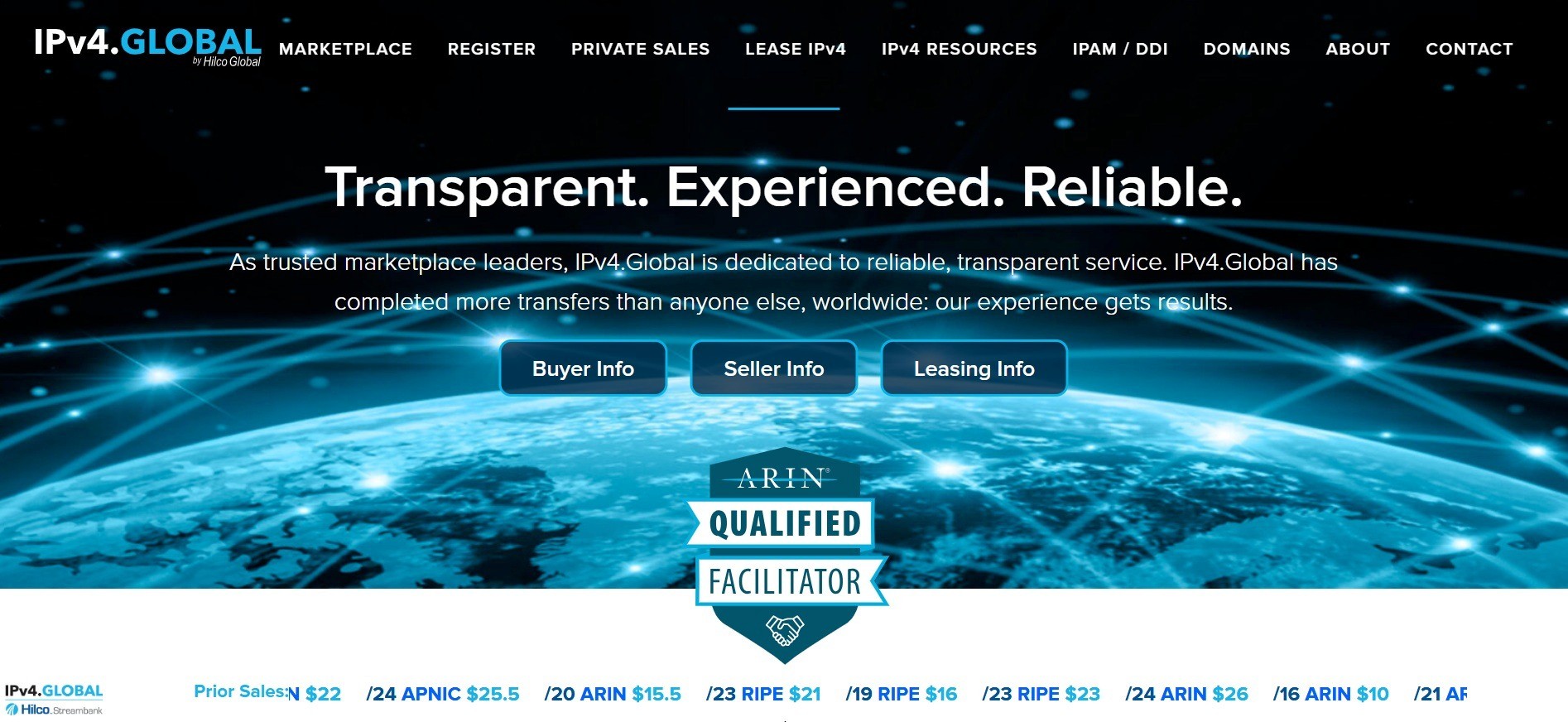
IPv4.Global: What It Is and Who It Suits
IPv4.Global is operated by Hilco Streambank, a division of Hilco Global. It has facilitated the transfer of more than 65 million IPv4 addresses and generated over $1.3 billion for its clients — a genuine track record, not a marketing claim. In September 2025, ORIX Corporation USA acquired a majority equity stake of approximately 71.4% in Hilco Global, giving the platform institutional backing that smaller competitors can't match.
The platform runs three transaction modes: an online auction marketplace for blocks /17 and smaller, private brokerage for /16s and above, and an IPv4 leasing hub added more recently alongside the core auction business. Primary RIR coverage is ARIN and RIPE, with inter-RIR transfers supported.
IPv4.Global is the right choice when: you're buying or selling a large block and want competitive, market-rate pricing through a proven platform with deep liquidity. For everything else - smaller blocks, fixed pricing, RIPE-specific workflows, or faster turnaround - the alternatives below are worth a close look.
Platform Comparison at a Glance
Platform | Model | Primary RIR | Buy/Sell | Auction | Provisioning |
IPv4.Global | Auction + Broker + Lease | ARIN + RIPE | Yes | Yes | Auction cycle |
IPbnb | Full marketplace | RIPE primary | Yes | No (fixed price) | ~24 hours |
IPXO | Leasing only | Multi-RIR | No | No | Automated |
InterLIR | Marketplace + Broker | RIPE + ARIN + others | Yes | No | ~24 hours |
Prefixx | Boutique broker | ARIN + RIPE + APNIC + LACNIC | Yes | No | Varies |
LogicWeb | Direct provider | ARIN + RIPE | No | No | Same day |
Which Platform Fits Your Situation
Use this as a starting point before reading the full platform descriptions below.
You need fixed pricing for procurement or budget approval → IPbnb. Lease rates and buy prices are published before you commit. There's no auction uncertainty, and you get actual human support along the way.
You're buying or selling a large block and want the best market rate → IPv4.Global. The auction model exists for exactly this. Deep liquidity, $1.3B+ track record.
You need leasing across multiple RIR regions with minimal management → IPXO. Mostly automated support, 97.7% of abuse cases resolved without human input. No buy/sell functionality.
You're in the RIPE region and want support navigating compliance documentation → InterLIR. Managed KYC, RIPE database operations, and transfer coordination included.
You have a complex or high-value transaction and want a specialist end-to-end → Prefixx. Zero buyer fees, escrow-protected, hands-on senior consultants.
You need clean subnets fast, month-to-month, no long-term commitment → LogicWeb. Same-day provisioning, monthly subscriptions, cancel anytime.
What to Check Before Committing to Any Platform
Pricing model - fixed or auction. If you need a confirmed number before committing to a budget or approval process, fixed-price platforms are the only workable option. Auctions make sense when you're flexible on cost and want market-rate price discovery.
RIR coverage and compliance depth. ARIN-primary and RIPE-primary platforms handle compliance differently. RIPE NCC's PA-space leasing framework, database update requirements, and 24-month transfer lock have implications that ARIN-focused platforms don't always handle natively. If you operate in the RIPE region, verify this before signing up.
Beyond those two: confirm the platform handles RPKI and ROA configuration as part of standard onboarding, provides a Letter of Authorization (LOA) at setup, and has a clear process for abuse complaints.
Also check whether the platform covers the full range of transactions you might eventually need. Starting on a leasing-only platform means switching later if you decide to buy or sell. A full marketplace avoids that.
Top 5 IPv4.Global Alternatives
1. IPbnb
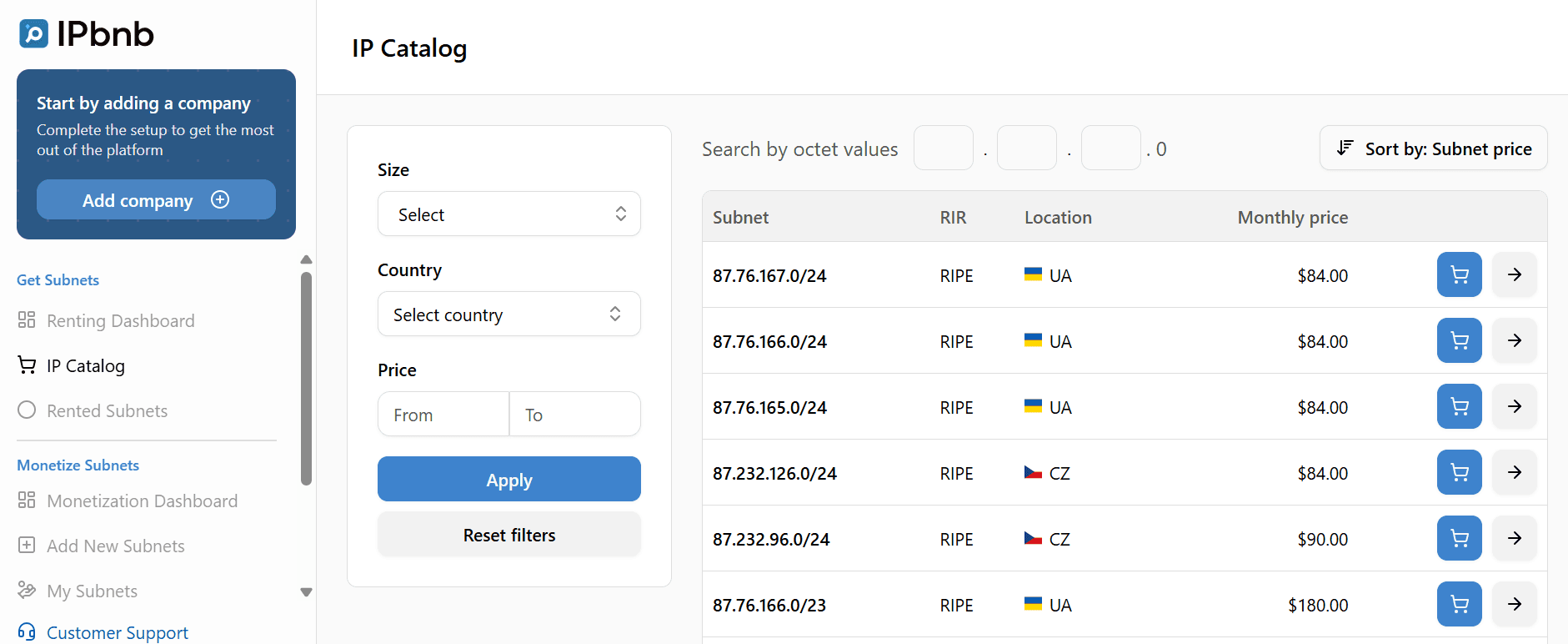
IPbnb is a two-sided IPv4 marketplace covering leasing, buying, selling, and transfers, with the RIPE NCC region as its primary focus. It's built for LIRs, hosting providers, ISPs, and enterprises that treat IPv4 as infrastructure capital - not just a resource to be accessed month-to-month.
The core difference from IPv4.Global is the pricing model. Rather than auction-based price discovery, IPbnb uses fixed, published rates - listed openly on the platform before any commitment. IP owners set their own terms; lessees and buyers transact directly and transparently. No auction cycle. No exclusivity requirement. No per-IP minimum fee.
Setup is straightforward - from account creation to first active deployment, onboarding is designed to complete within 24 hours of verification. RPKI and ROA configuration are included as standard. The full transaction spectrum - lease, buy, sell, transfer - is available within a single account, which matters for businesses whose needs change over time.
IPbnb suits RIPE-region operators who need predictable pricing for procurement or budgeting, IP owners who want control over their listings and direct visibility into how their space is being used, and organizations that want to lease now with the option to buy or sell later - all without switching platforms.
Transaction types: Lease, buy, sell, transfer
Primary RIR: RIPE NCC
Lease pricing: fixed, published
Platform fee: None for lessees
Provisioning: ~24 hours
Self-service: Yes
Use IPbnb's pricing calculator to estimate your monthly lease cost by block size.
2. IPXO
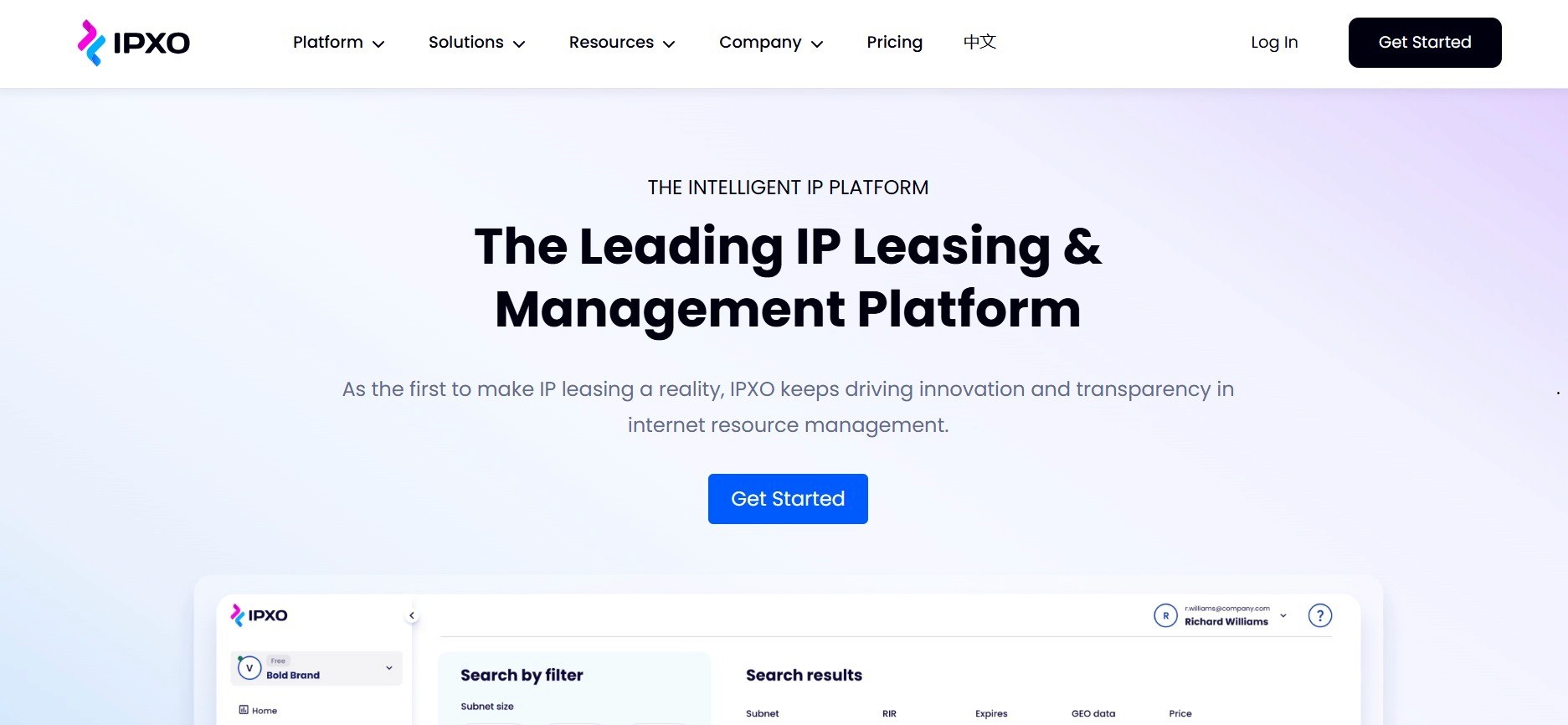
IPXO is a leasing-only platform with coverage across RIPE, ARIN, APNIC, and other RIR regions. Its model is a managed pool: IP owners assign their subnets to IPXO, which aggregates the inventory and leases it to end users, handling RPKI, abuse management, and subnet delivery automatically.
The automation is genuinely strong. IPXO resolves roughly 97.7% of abuse cases without human intervention, which meaningfully reduces the operational burden for both IP owners and lessees. Average lease rates on the platform ran at approximately $0.40 per IP per month through 2025, with utilization consistently above 80%.
The trade-off is visibility and control. IP owners on IPXO don't set their own lease terms, don't choose their lessees, and don't have direct insight into how their space is being used day to day. The platform charges a 5% fee on transactions. And because IPXO is leasing-only, there's no path to buying or selling address space through the platform.
IPXO fits businesses that need leasing at scale across multiple RIR regions with minimal hands-on management, and IP owners who prefer a passive, automated monetization model over direct control.
3. InterLIR
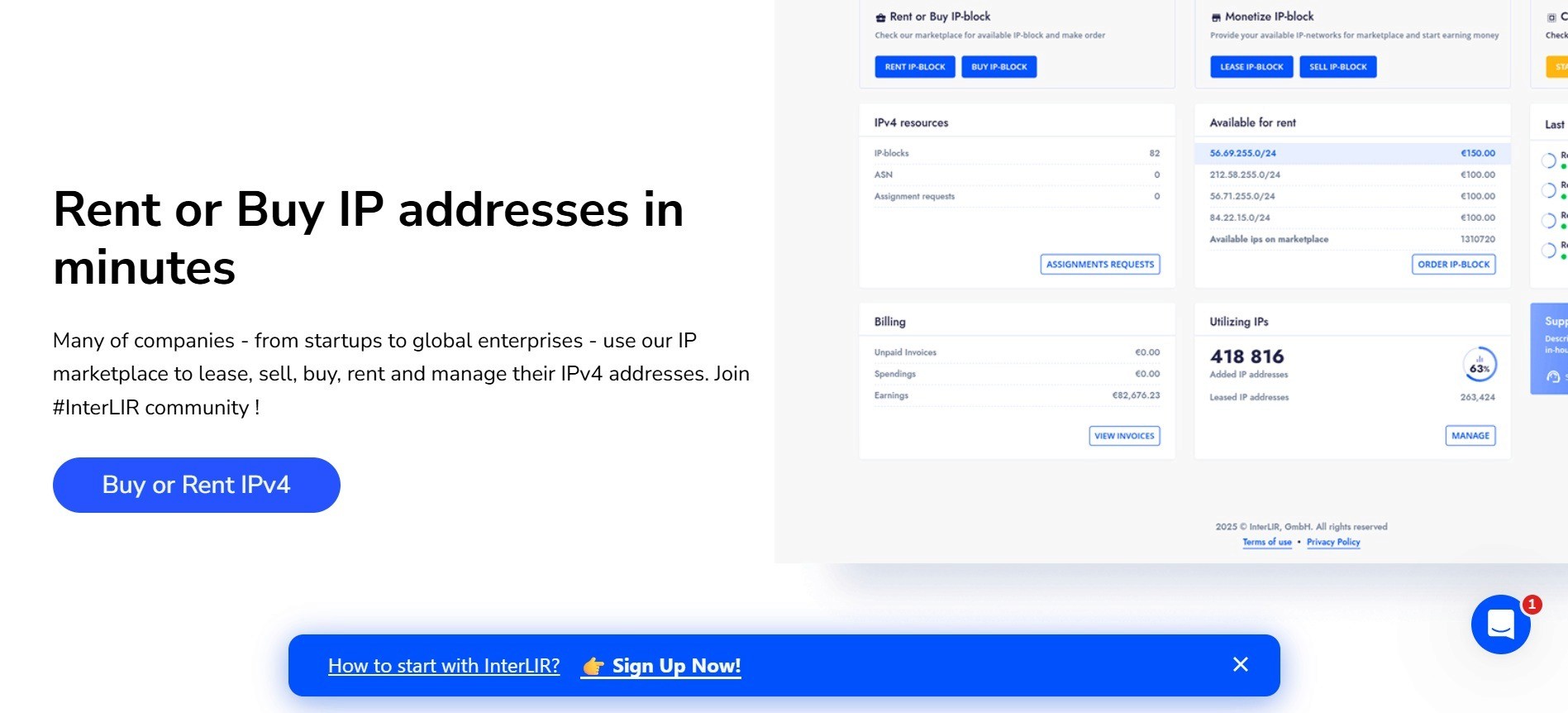
InterLIR is a Berlin-based IPv4 marketplace founded in 2020, with legal entities in both the EU (InterLIR GmbH) and the US (InterLIR LLC). It covers leasing, buying, and selling across RIPE, ARIN, APNIC, LACNIC, and AFRINIC, with a stated focus on European compliance standards.
Where InterLIR distinguishes itself is managed compliance support. The platform handles RIPE database operations, KYC workflows, and transfer coordination - useful for organizations that need guidance through those processes rather than a fully self-service experience.
Provisioning for leasing is typically within 24 hours. Fee structures for leasing and brokerage are quoted per transaction rather than published as a flat rate.
InterLIR is a good fit for operators who want marketplace functionality alongside human support on compliance and documentation - particularly those transacting in the RIPE region who prefer not to self-navigate the transfer procedures.
4. Prefixx
Prefixx is a boutique IPv4 broker founded in 2018, covering ARIN, RIPE NCC, APNIC, and LACNIC. The positioning is deliberate: senior consultants handle every transaction directly, rather than routing clients through a self-service interface.
The fee structure is worth highlighting. Buyers pay nothing - Prefixx charges sellers a commission of 3–8% depending on block size, which covers the full cost of the transaction from the buyer's side. Funds go into escrow before any transfer begins and are released only after RIR confirmation. Every block passes through Prefixx's "Tixx" due diligence process - blacklist scanning, IP reputation checks, geolocation verification, and abuse history review - before reaching a buyer.
For leasing, the rate includes LOA documentation, RPKI configuration, reverse DNS management, and ongoing white-glove support, with no hidden add-on charges.
The trade-off is self-service. Prefixx doesn't have an independent dashboard where clients can configure and transact on their own. For businesses that want to operate independently, that's friction. For those who prefer a fully managed experience, it's exactly the point.
Prefixx suits organizations executing complex or high-value transactions where senior specialist involvement is worth more than full self-service control - and buyers who want zero upfront brokerage cost with solid block due diligence included.
5. LogicWeb
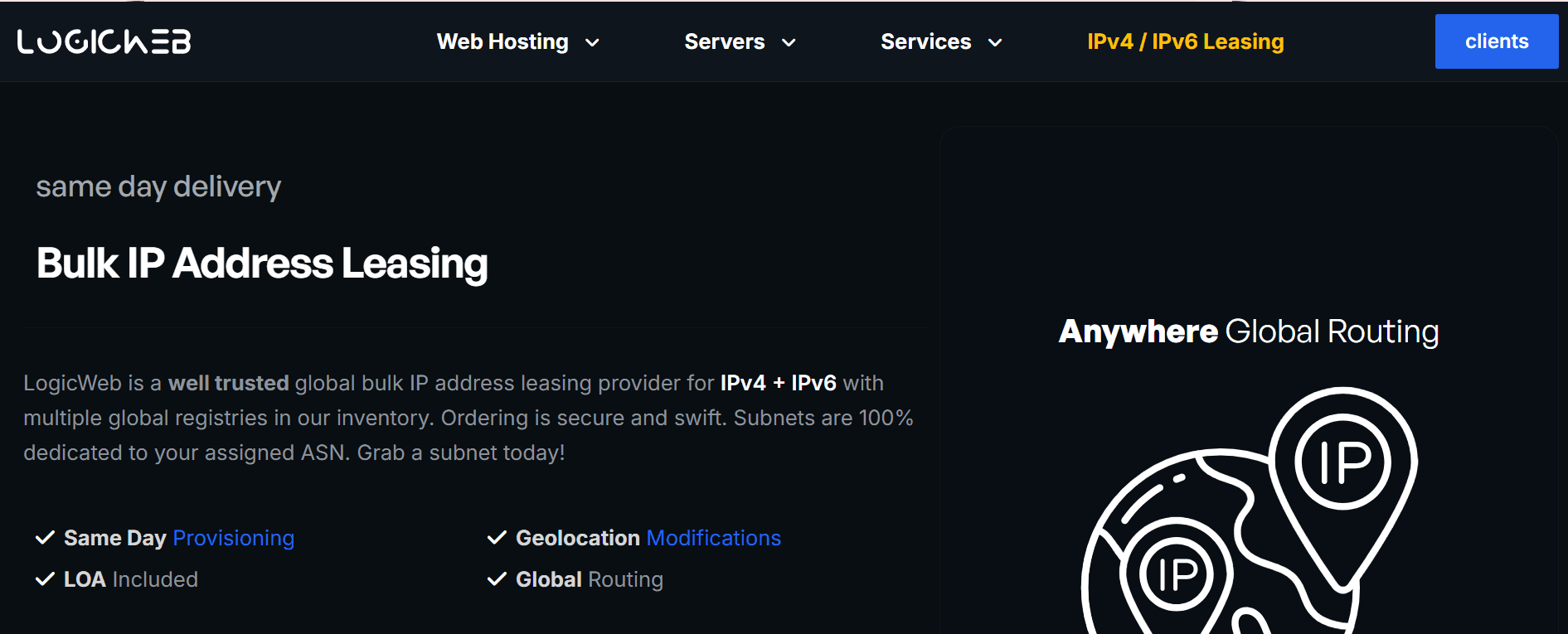
LogicWeb is a direct IPv4 and IPv6 subnet provider that has been operating since 2004. It's not a marketplace or a broker - it owns the address space in its inventory (500,000+ IPv4 addresses) and leases it directly to customers, with no buying or selling capability.
The model is built for speed and simplicity. Orders are processed with LOA delivery typically within an hour during business hours. There are no long-term contracts - LogicWeb runs on monthly subscriptions that can be cancelled before the first of any month. RPKI, IRR route objects, WHOIS updates, geolocation modifications, and DNS delegation are all included at no extra cost. NordVPN, Private Internet Access, and other VPN infrastructure operators use the platform for flexible, clean IP supply.
Inventory covers ARIN and RIPE registries, with standard block sizes from /24 to /22. One limitation to flag: LogicWeb's legacy subnets (prefixes beginning with 149.x and 154.x) don't support RPKI/ROA - only IRR route objects. If full RPKI coverage is a hard requirement, verify subnet availability before ordering.
LogicWeb is a strong option for operators who need fast access to routable address space on a month-to-month basis - particularly VPN and proxy providers with flexible scaling needs. It's not the right choice for anyone who might want to buy, sell, or permanently transfer address space.



FAQ
Is IPv4.Global the best place to buy IPv4?
IPv4.Global is one of the most established IPv4 platforms in the world, with over $1.3 billion in completed transfers and a long track record across both auction and private brokerage. For large-block transactions - especially where competitive price discovery is the priority - it's a strong choice. If your needs are different - smaller blocks like /24 to /21, fixed-price leasing, or faster provisioning without an auction cycle - platforms like IPbnb are built specifically for that use case.
Which IPv4 marketplace has fixed pricing?
IPbnb operates on fixed, published pricing - lease rates and buy prices are listed openly on the platform before any commitment. InterLIR also publishes buy prices on its platform. Fixed pricing gives buyers and IP owners a clear number to work with before committing - which is the main advantage over auction-based platforms.
What's the main difference between IPv4.Global and IPbnb?
The core difference is how prices are set and which block sizes each platform serves best. IPv4.Global uses an auction model optimized for large-block transactions - the final price is determined by competitive bidding, and it's the market's leading venue for /16s and major brokerage deals. IPbnb uses fixed pricing with published rates and is built specifically for RIPE-region operators who need smaller blocks (/24–/21), fast provisioning, and a single platform for leasing, buying, and selling.